Best Calorie Tracker Apps Compared: A 2026 Guide
Core Mechanisms of a Top Calorie Tracker App
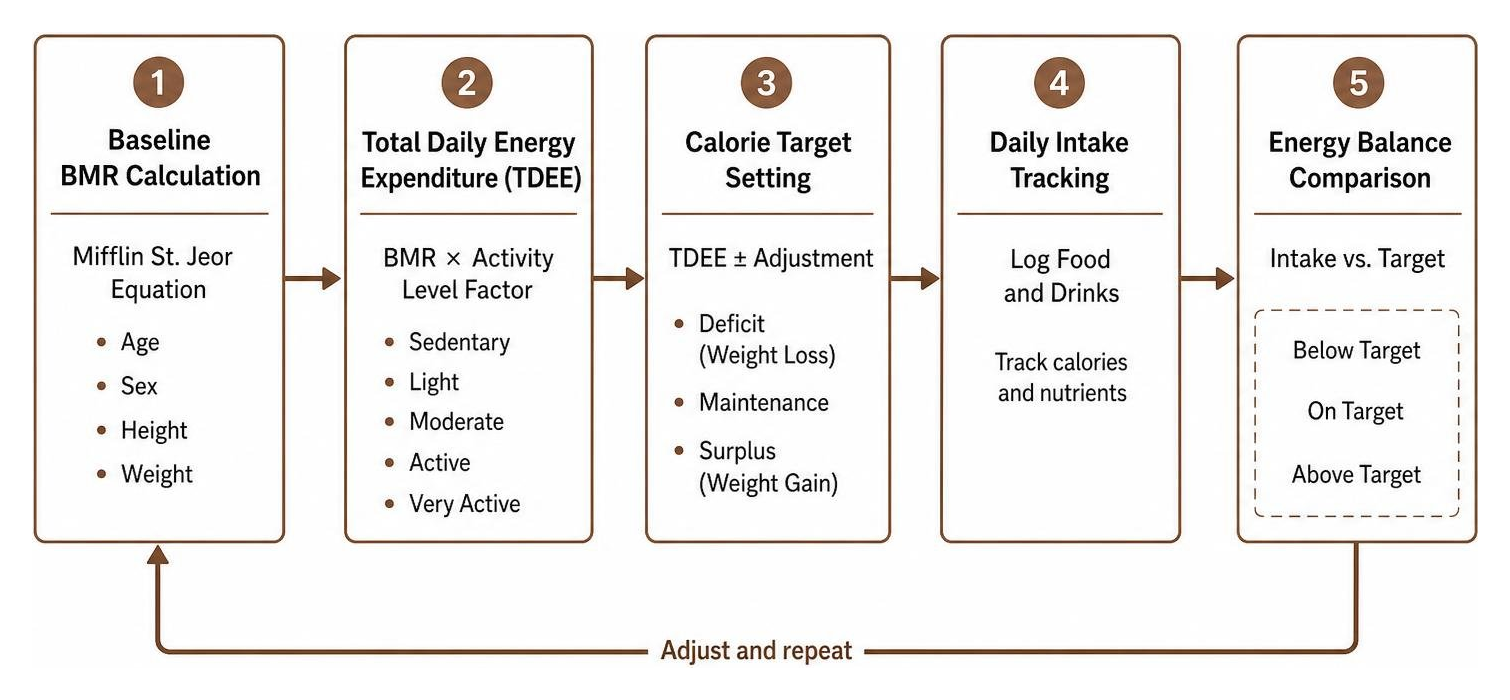
At its foundation, every calorie tracker app operates on a simple principle: energy balance. To lose weight, gain muscle, or maintain your current composition, you need to understand how much energy your body spends each day versus how much energy you consume through food and drink.
Modern nutrition science relies heavily on validated mathematical formulas to establish your baseline energy requirements. When you set up a food diary or nutrition tracker, the software estimates your Basal Metabolic Rate (BMR)—the calories your body burns at rest just to keep your heart pumping, lungs expanding, and cells functioning.
How Daily Energy Expenditure and BMR Are Calculated
To set personalized daily intake targets, most top health applications utilize the Mifflin St. Jeor equation. Clinical studies consistently show that the Mifflin St. Jeor formula estimates baseline energy needs accurate within 10% of actual metabolic output for the majority of adults.
Once your BMR is calculated based on your age, biological sex, height, and current weight, the app applies an activity multiplier to determine your Total Daily Energy Expenditure (TDEE). This multiplier accounts for your job's movement demands and standard daily routines.
From this TDEE baseline, the software calculates your daily intake goals based on your primary objective:
- Weight Loss: A standard deficit of 500 calories per day under your TDEE generally produces about 1 pound of weight loss per week.
- Muscle Gain: A modest surplus of 250 to 500 calories above your TDEE supports lean tissue growth when paired with resistance training.
- Maintenance: Setting intake equal to your TDEE keeps weight stable over time.
To learn more about calculating targets and selecting the ideal tool for your routine, check out our guide on the Best App for Measuring Calories.
Evaluating Macronutrients, Micronutrients, and Exercise Accuracy
While calorie balance dictates overall body mass changes, macronutrients—protein, carbohydrates, and fats—dictate body composition and metabolic health.
A well-rounded calorie tracker app allows you to break down daily intake into specific macro targets:
- Protein Distribution: Essential for repairing tissue and preserving lean muscle while in a calorie deficit (4 calories per gram).
- Carbohydrates & Net Carbs: Primary energy source for workouts, tracked as total or net carbs (total carbs minus fiber and sugar alcohols) for blood sugar management (4 calories per gram).
- Dietary Fats: Crucial for hormone production and nutrient absorption (9 calories per gram).
Beyond macros, micronutrients like sodium, potassium, calcium, and iron help you maintain key physiological functions.
However, users must remain critical of exercise calorie-burn estimates. Wearables and in-app workout logs often overestimate energy expenditure by 20% or more. If you automatically "eat back" all burned calories displayed by your smartwatch, you may unknowingly eliminate your planned energy deficit. Using an offline, structured Exercise Log allows you to record workout volume without relying on inflated calorie burn estimates.
Advanced Logging Tools and Hardware Integrations
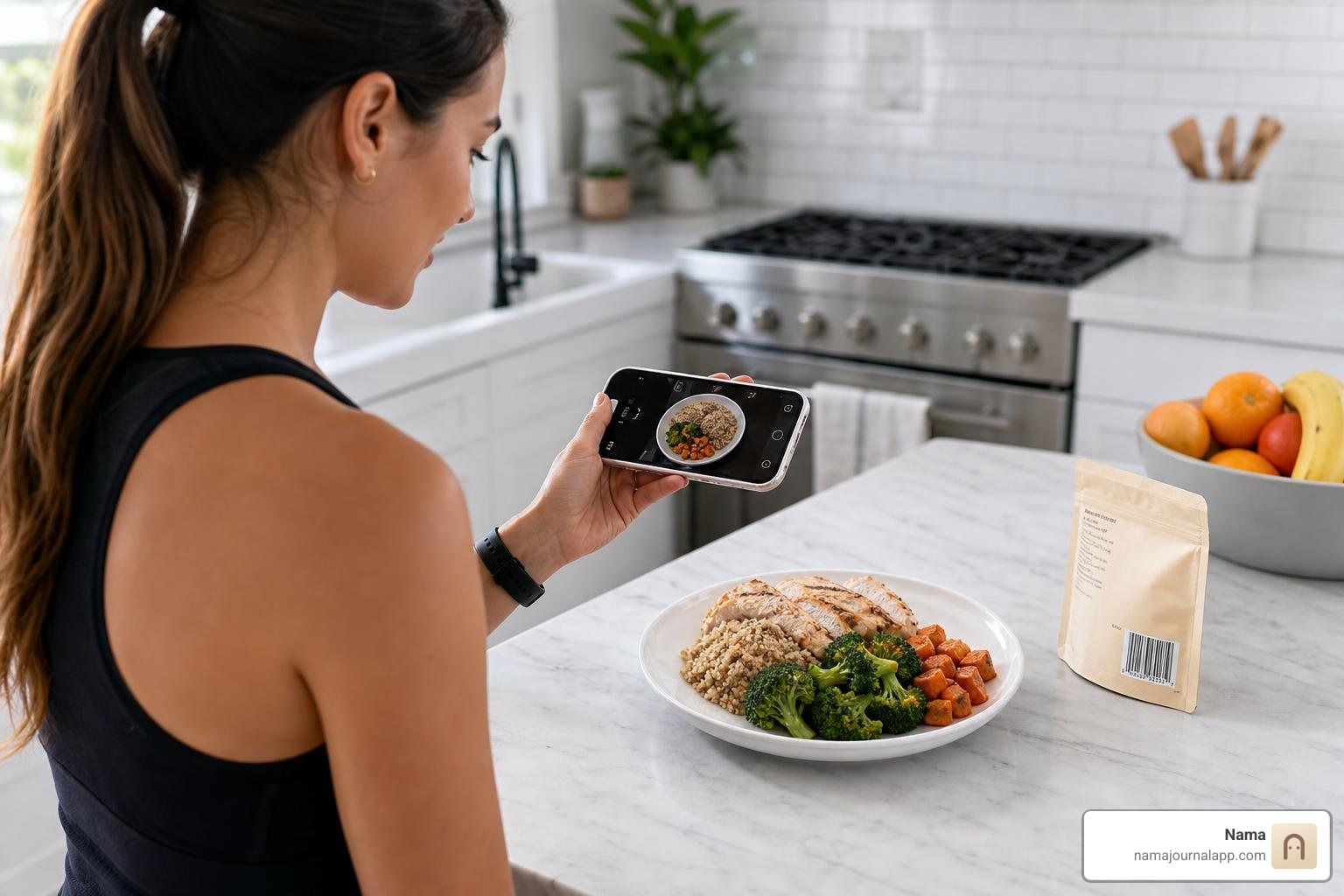
Logging every meal manually by typing keywords can quickly lead to decision fatigue. Modern nutrition applications leverage camera sensors, natural language processing, and wireless device protocols to make logging fast and effortless.
AI-Powered Meal and Voice Recognition
The visual and auditory input tools available in 2026 drastically shorten the time required to log complex meals:
- Barcode Scanning: Quickly scans packaged goods to pull accurate, verified nutrition labels directly into your daily journal.
- Camera Plate Recognition: Uses AI computer vision to identify unlabelled home meals, estimating food components and portion sizes directly from a single photo.
- Voice Food Logging: Allows you to speak naturally—for example, saying "Two scrambled eggs, two slices of whole wheat toast, and an avocado"—and automatically converts your speech into itemized entries with macros.
Combining AI meal logging with a consistent, flexible Food Diary helps build sustainable habits without taking up your entire morning.
Wearable Syncing and Ecosystem Integration
To build a full picture of your health, modern applications exchange background data with platforms like Apple Health, Google Health Connect, and connected fitness wearables.

Automated integrations streamline your routine by background-syncing key metrics:
- Daily Step Counts: Automatically adjusts baseline movement activity without manual input.
- Heart-Rate Tracked Workouts: Logs session durations and cardiovascular intensity trends directly to your timeline.
- Body Composition: Smart scales sync daily weight measurements to track long-term trendlines, filtering out normal day-to-day fluid fluctuations.
Free vs Premium Tier Features and Dietary Specializations
Most commercial nutrition apps use a freemium business model, keeping basic search tools free while putting advanced metrics, custom goals, and automation behind monthly or annual paywalls.
| Feature Category | Basic Free Tier | Premium Subscription Tier |
|---|---|---|
| Database Access | Text search across general databases | Verified database items & restaurant menus |
| Logging Tools | Manual text search, manual recipe input | Barcode scan, camera photo logging, voice input |
| Nutrient Targets | Standard daily calorie & fixed macro ratios | Custom macro targets by day/meal, fiber/net carb focus |
| Specialized Tools | Basic weight history logging | GLP-1 tracking, intermittent fasting timers, export options |
Free vs Premium Features in a Calorie Tracker App
While free tiers offer solid baseline tracking, upgraded plans cater to individuals with specialized athletic or metabolic needs.
If you are pursuing aggressive body recomposition, fixed macro percentages may not cut it. Premium plans usually let you assign explicit gram targets for protein, fat, and carbohydrates, or shift targets depending on whether it is a training day or a recovery day. Advanced subscription levels also offer automated recipe calculators that divide bulk batch-cooked meals into exact per-serving nutrients.
To explore customizable, flexible metric tracking options without recurring fees, take a look at our full suite of Features.
Managing Diabetes, Keto, and Specialized Diets
For users managing medical conditions or strict nutritional protocols, a standard calorie counter falls short if it cannot monitor specialized physiological markers.
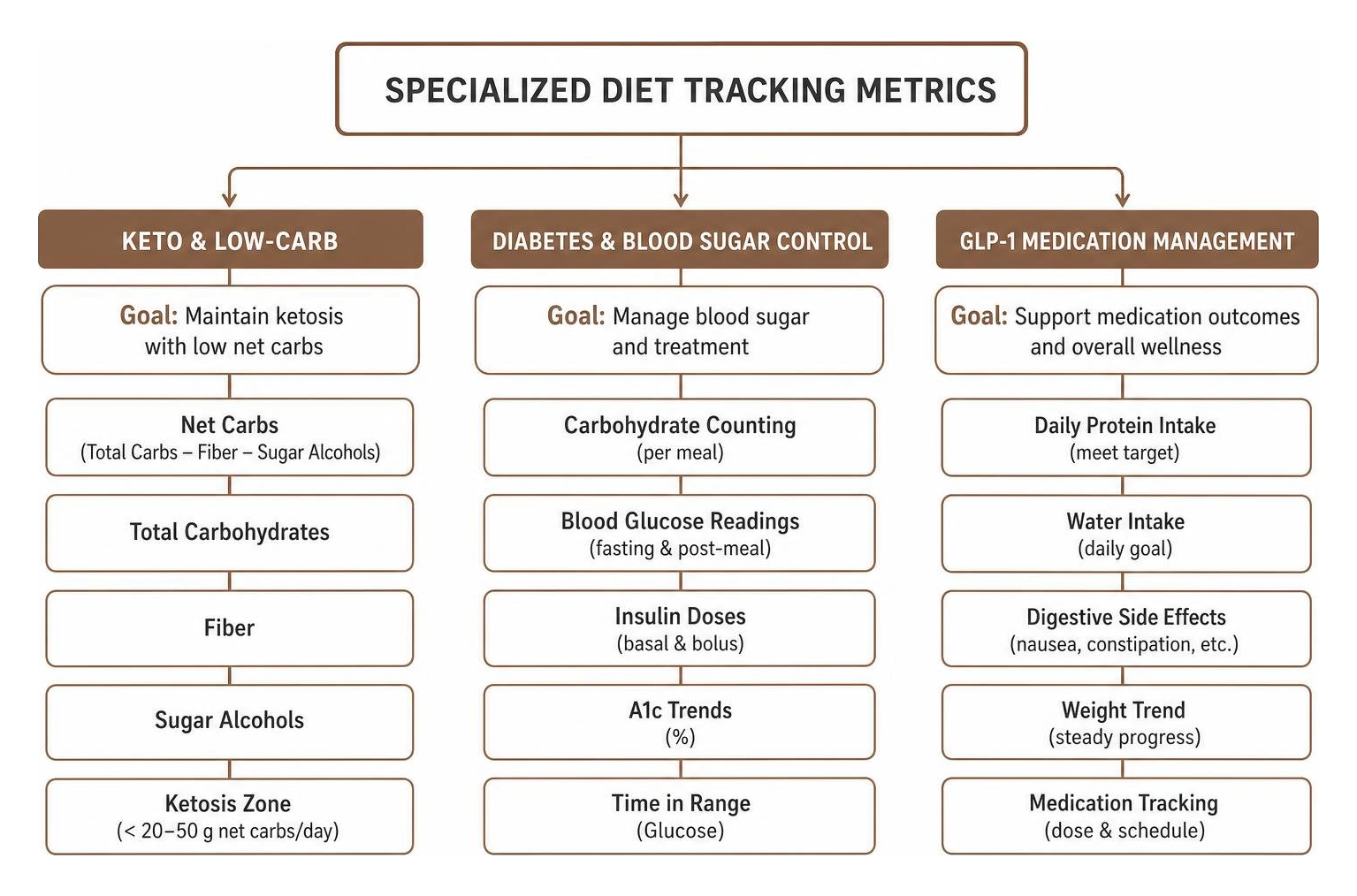
- Ketogenic & Low-Carb Diets: These protocols require tracking net carbohydrates (Total Carbs minus Fiber and Sugar Alcohols). Keeping net carbs below 20–50 grams daily encourages ketosis, where the body burns fat for fuel instead of glucose.
- Diabetes & Blood Sugar Control: Carbohydrate counting is critical for individuals managing Type 1 or Type 2 diabetes to predict post-meal blood sugar spikes. Dedicated medical trackers log meal carbohydrate loads alongside insulin dosages, A1c test trends, and capillary blood glucose readings.
- GLP-1 Medication Management: For individuals taking GLP-1 receptor agonists, specialized app interfaces help monitor daily protein thresholds, water intake, and potential digestive side effects alongside steady weight trends.
How to Select the Right App and Avoid Common Pitfalls
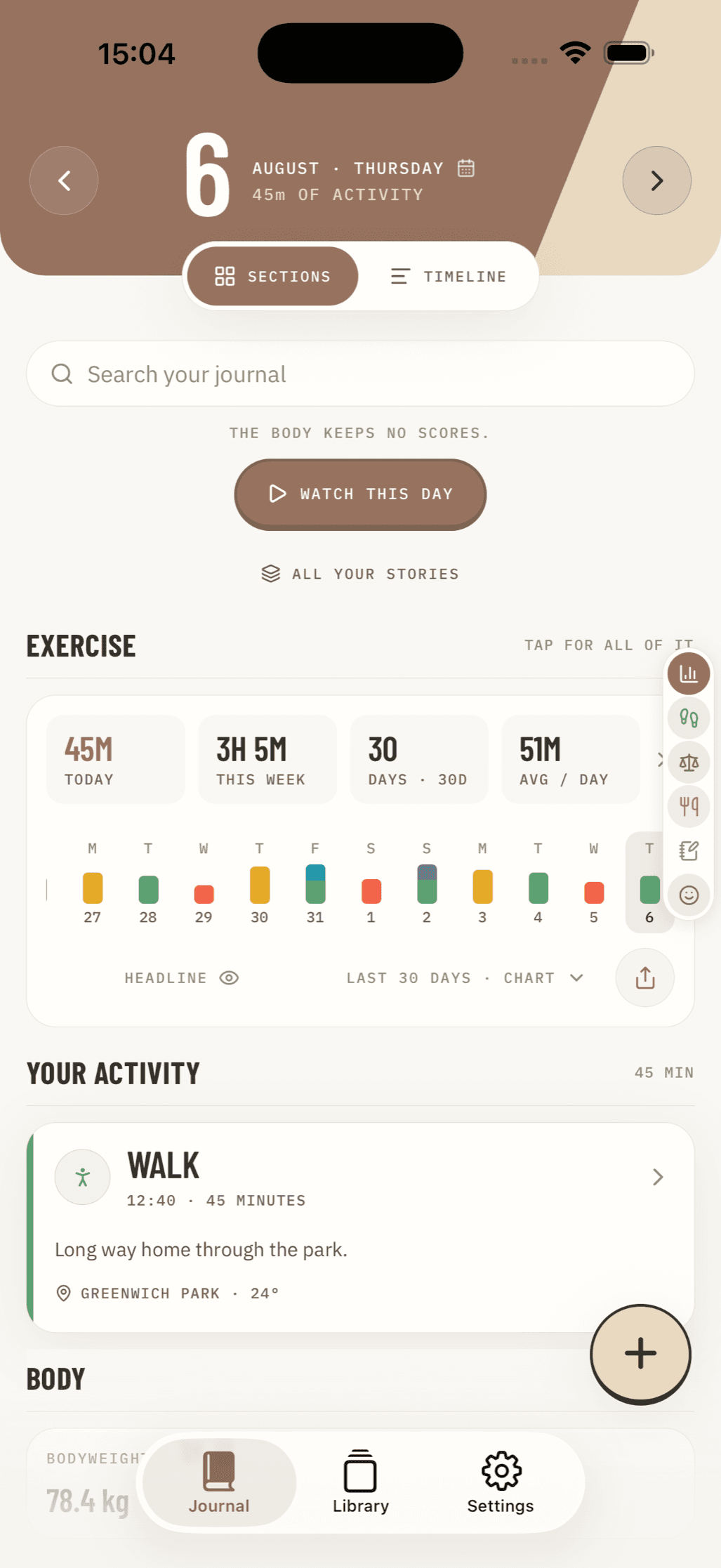
Even the most accurate calorie tracker app will fail if user fatigue or unverified data entry corrupts your records. Choosing an app that fits your personal workflow and values is the best way to stick with your tracking routine long term.
Common Tracking Errors and How to Overcome Them
If your weight trend stalls despite staying within your digital calorie allowance, one of four common tracking errors is usually the culprit:
- Misjudging Portion Sizes: Eyeballing dense foods like peanut butter, nuts, and cooking oils can introduce hundreds of unaccounted calories. Using a digital kitchen scale to measure in grams eliminates estimation errors.
- Relying on Unverified User Entries: Open, crowd-sourced food databases are convenient, but they often contain missing macronutrients or inaccurate calorie counts. Always verify crowd-sourced items against physical food labels.
- Forgetting Liquid Calories and Cooking Fats: Salad dressings, coffee creams, butter, and frying oils are high in calories but easy to forget. Logging these consistently keeps your daily journal accurate.
- Overestimating Workout Calorie Burn: Cardiovascular equipment and smartwatch displays often overestimate energy expenditure. Treat exercise estimates as general fitness trends rather than an excuse to increase daily food portions.
Choosing a Privacy-First Calorie Tracker App
Most modern health apps store your detailed lifestyle logs—what you eat, when you exercise, your weight trends, and medical notes—on external cloud servers. These servers can profile your personal information for targeted ads or sell aggregated data to third parties.
If you prefer complete control over your private health data, Nama offers a fresh, privacy-focused approach to daily tracking.
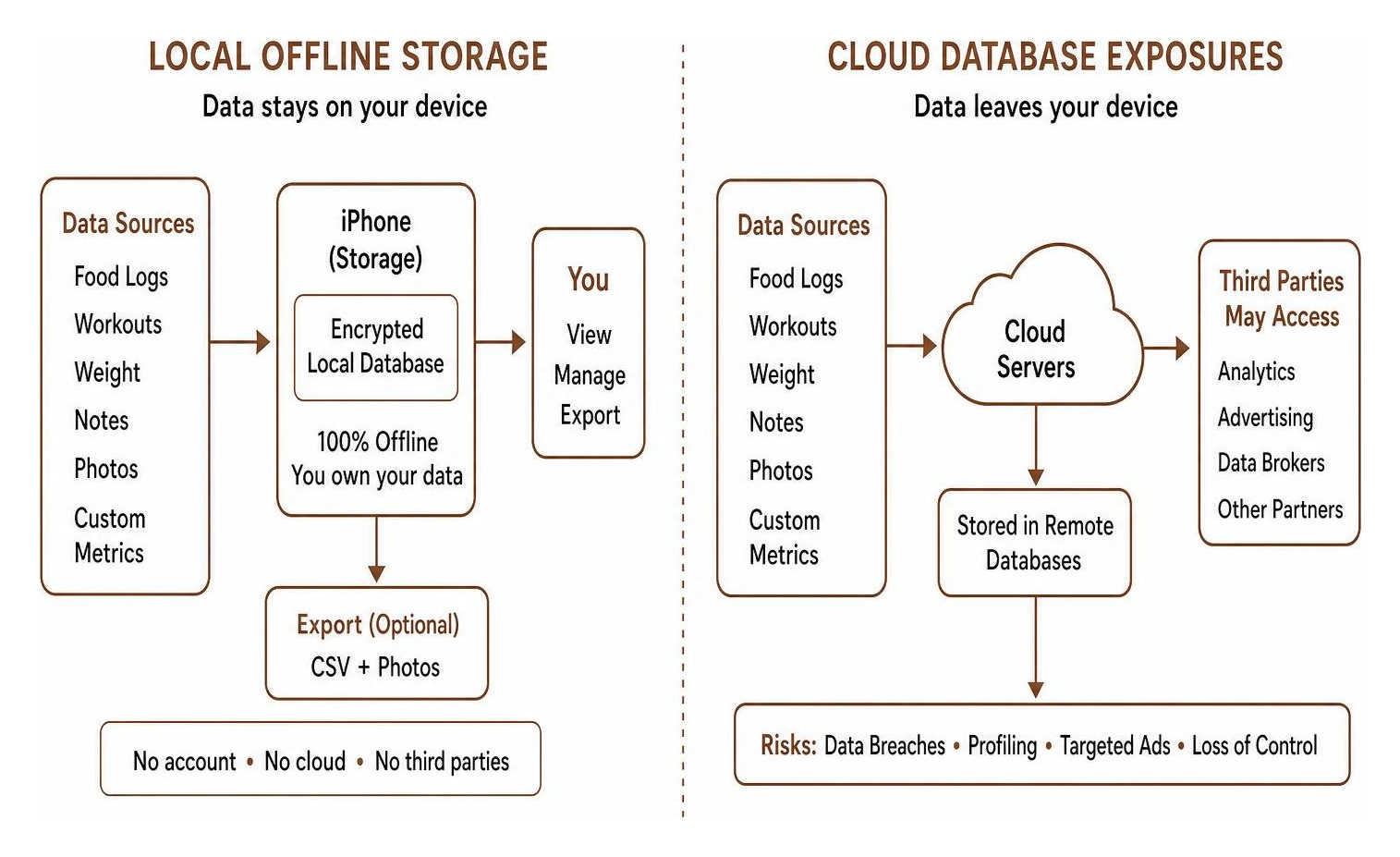
Nama is a private iOS wellness-journal app built specifically to give you absolute data ownership:
- 100% Offline Storage: Your journal entries, food photos, and health metrics are saved exclusively on your iPhone—never sent to cloud servers.
- No Account Required: You can start tracking instantly without entering an email address, creating passwords, or sharing personal contact details.
- Custom Metric Freedom: Track calories, macros, workouts, mood, and custom daily habits in one distraction-free place using our flexible Track Anything architecture.
- Complete Data Export: Export your entire journal history and uploaded photos to CSV files at any time. This makes it easy to analyze your data in spreadsheets or share organized notes with your doctor or dietitian.
Frequently Asked Questions About Calorie Tracking
How accurate are calorie and exercise burn estimates in digital apps?
Food database accuracy varies based on the verification standards of the app. Databases that rely on verified food labels or official USDA nutrition datasets generally hit within 1% to 5% of actual intake values. Crowd-sourced, open-entry databases carry a much higher error margin due to user input typos.
For energy expenditure, software formulas like the Mifflin St. Jeor equation estimate baseline daily calories within 10% of real-world needs for most adults. However, exercise burn figures provided by smartwatches and fitness gear can overestimate energy burn by 20% to 40%. It is best to treat workout burn data as an indicator of relative exercise effort rather than a license to consume extra calories.
How does carbohydrate counting aid in diabetes and keto management?
Carbohydrate counting gives individuals with diabetes a precise estimate of how incoming meals will convert to blood glucose. Matching carb consumption to physical activity levels or medication doses helps prevent sharp blood sugar spikes and drops.
For keto dieters, calculating net carbohydrates (Total Carbs minus Dietary Fiber and Sugar Alcohols) shows how many digestible carbs are entering the system. Keeping net carb totals below specific thresholds preserves ketosis, helping the body rely on dietary and stored fats as its primary energy source.
What is the best way to determine daily calorie and macro goals?
Start by calculating your baseline energy needs using an established BMR formula like Mifflin St. Jeor, then apply an activity factor to find your total daily calorie burn (TDEE).
For safe, gradual weight loss, subtract 500 calories per day from your TDEE to aim for roughly one pound of weight loss per week. Next, distribute those calories into balanced macros: set a solid protein goal first to protect lean muscle, then split your remaining calories between dietary fats and carbohydrates based on your preferred diet style and training intensity.
Conclusion
The ideal calorie tracker app isn't the one with the flashiest marketing—it's the one that seamlessly fits your daily routine, gives you clear nutrition insights, and respects your personal data boundaries.
If you want massive, crowd-sourced food databases with automatic camera recognition, modern AI platforms offer powerful tools to streamline logging. But if your main goal is simple daily consistency, complete data ownership, and zero privacy concerns, an offline tracking system is often the better path forward.
By measuring your daily meals accurately, staying mindful of exercise burn overestimations, and choosing a secure tracking system built for your needs, you can turn daily nutrition records into steady, long-term health results.
Ready to take total control over your health metrics without sacrificing your personal privacy? Visit our Blog to learn more about private health tracking, or explore how to Take control of your daily wellness data with Nama today.