Mastering Emotional Clarity with a Daily Self Awareness Journal and Printable Prompts
Start a Self Awareness Journal for Clearer Emotions
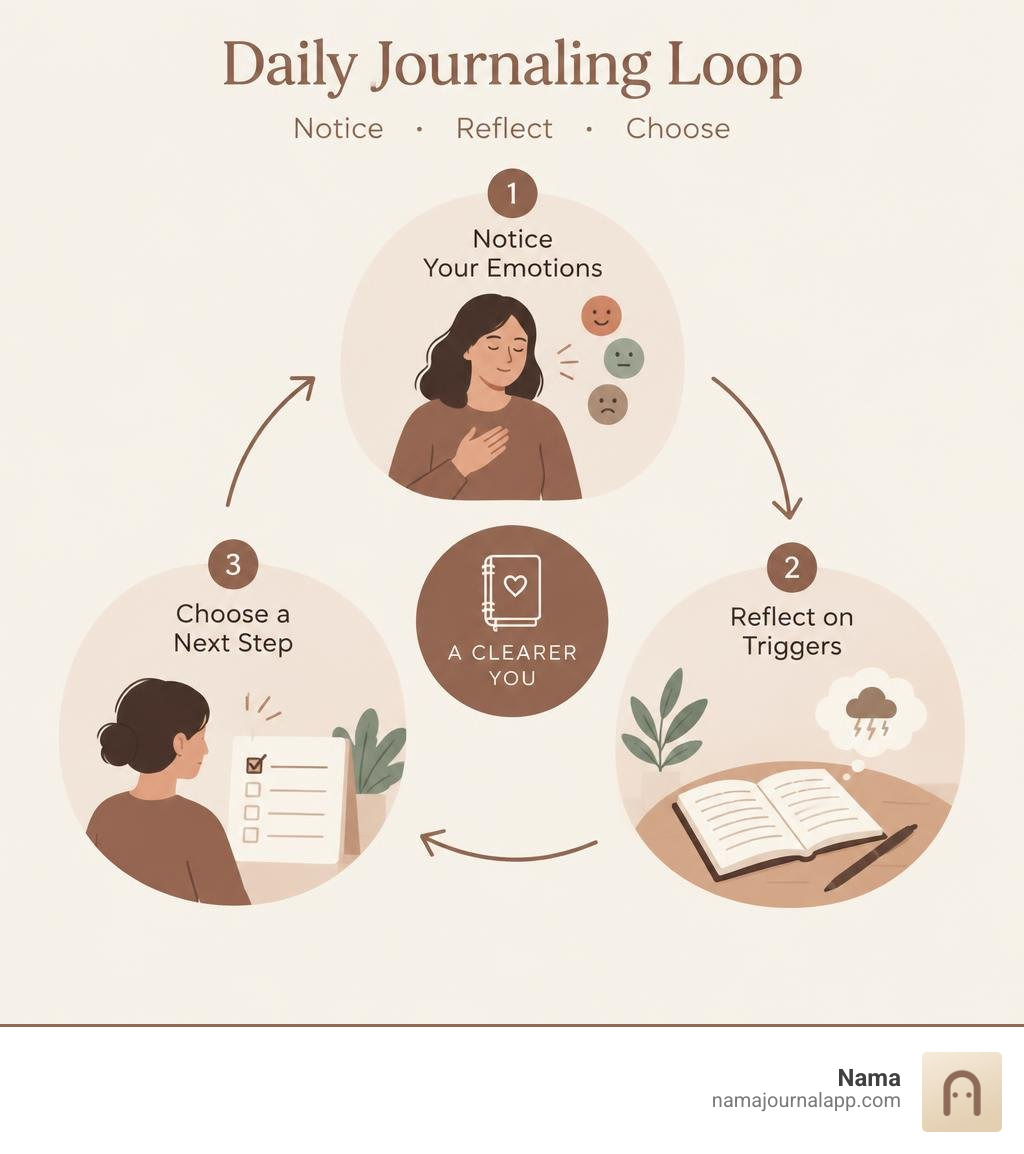
A self awareness journal is a private place to notice what you feel, think, and do - then spot the patterns behind those experiences. To begin, spend 5 to 10 minutes each day writing:
- What emotion am I feeling right now?
- What may have caused it?
- What do I need, or what is one helpful next step?
This small practice turns vague stress, irritation, or low energy into information you can use. Over time, your entries can reveal emotional triggers, routines that support you, and gaps between your values and your actions.
Unlike a diary that may simply record events, a self-awareness practice asks why an event mattered and how you responded. You can keep it fully offline and include the parts of daily life that affect your well-being, such as mood, movement, meals, sleep, and boundaries. The goal is not perfect writing. It is honest observation without judgment.
Research on reflective and expressive writing links regular journaling with lower stress symptoms, better emotional processing, and stronger focus. This guide shares practical prompts and a simple daily rhythm to help you build that insight without ads, feeds, or unwanted sharing.
Glossary for self awareness journal:
The Science and Benefits Behind a Daily Self Awareness Journal
Most of us spend our waking hours reacting to incoming emails, urgent deadlines, and buzzing notifications. We rarely pause to ask why a specific meeting drained our energy or why a passing comment spiked our heart rate. Over 200 empirical studies confirm that regular, structured journaling enhances overall well-being, sharpens cognitive focus, and supports long-term mental health.
When we practice expressive writing—sitting down to translate complex internal states into written language—we engage in emotional regulation. Research published in BMJ Open highlights that reflective journaling can significantly reduce mental health symptoms, showing up to a 9% measurable improvement for anxiety. Furthermore, clinical trials demonstrate that writing about stressful or difficult experiences for 15 to 30 minutes over several targeted sessions can reduce physiological cortisol levels by up to 23%.
Establishing a dedicated self-care journal bridges the gap between raw emotion and rational action. Instead of allowing subconscious stressors to dictate our choices, intentional self-inquiry provides the psychological safety needed to cultivate genuine emotional intelligence. Nearly 88% of active journalers report improved daily focus and sounder judgment because their minds are no longer bogged down by unprocessed mental clutter.
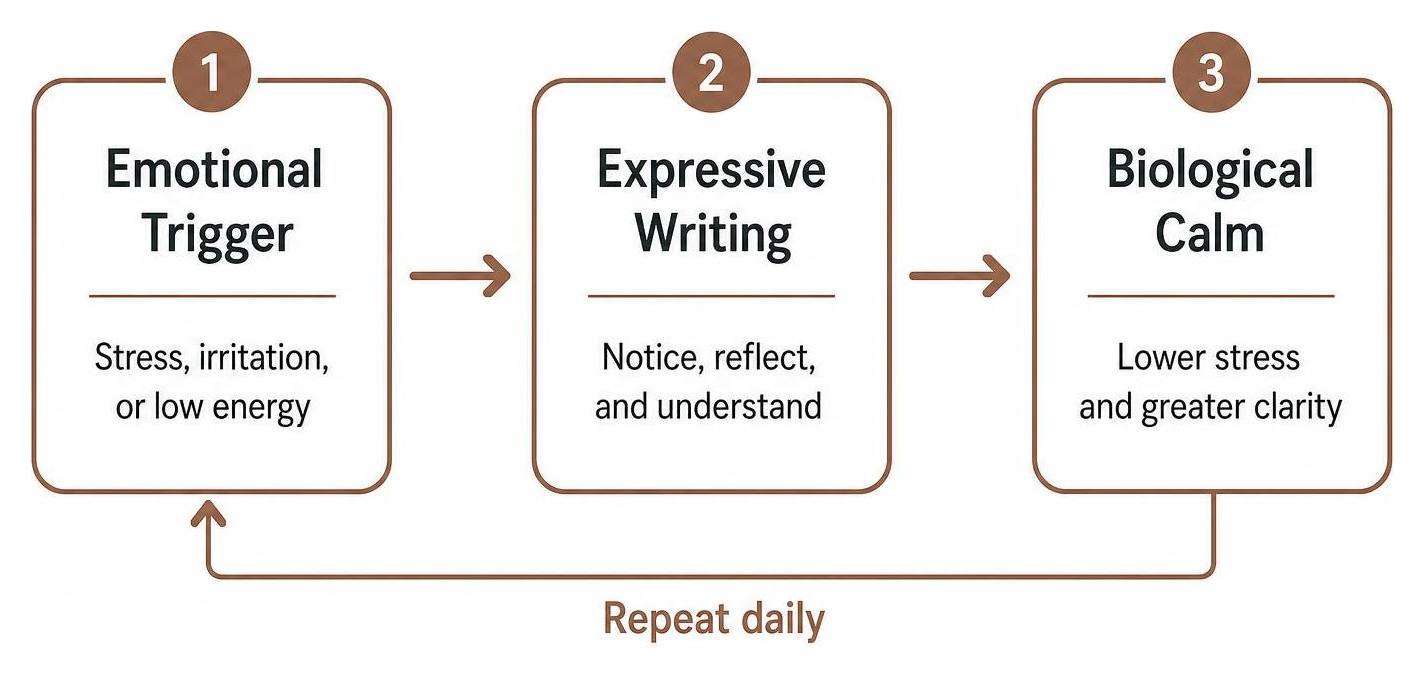
Neurological and Emotional Regulation Benefits
The mechanics of reflective writing operate directly on the brain's neural architecture:
- Prefrontal Cortex Activation: Translating feelings into words stimulates the ventrolateral prefrontal cortex, which exerts top-down control over emotional impulses.
- Amygdala Calming: Labeling emotional states reduces hyperactivity in the amygdala, shifting the body out of an acute "fight-or-flight" stress state.
- Working Memory Enhancement: Getting intrusive thoughts out of our head and onto a private page frees up finite working memory capacity, boosting problem-solving skills and mental stamina.
- Cognitive Reframing: Written self-disclosure allows us to examine cognitive distortions objectively, transforming catastrophic thinking into constructive solutions.
For those who prefer a streamlined digital habit, using a privacy-focused mood tracker app provides quick daily data points alongside your narrative entries, making mood stabilization tangible over months of reflection.
Traditional Diary vs. Reflective Introspection
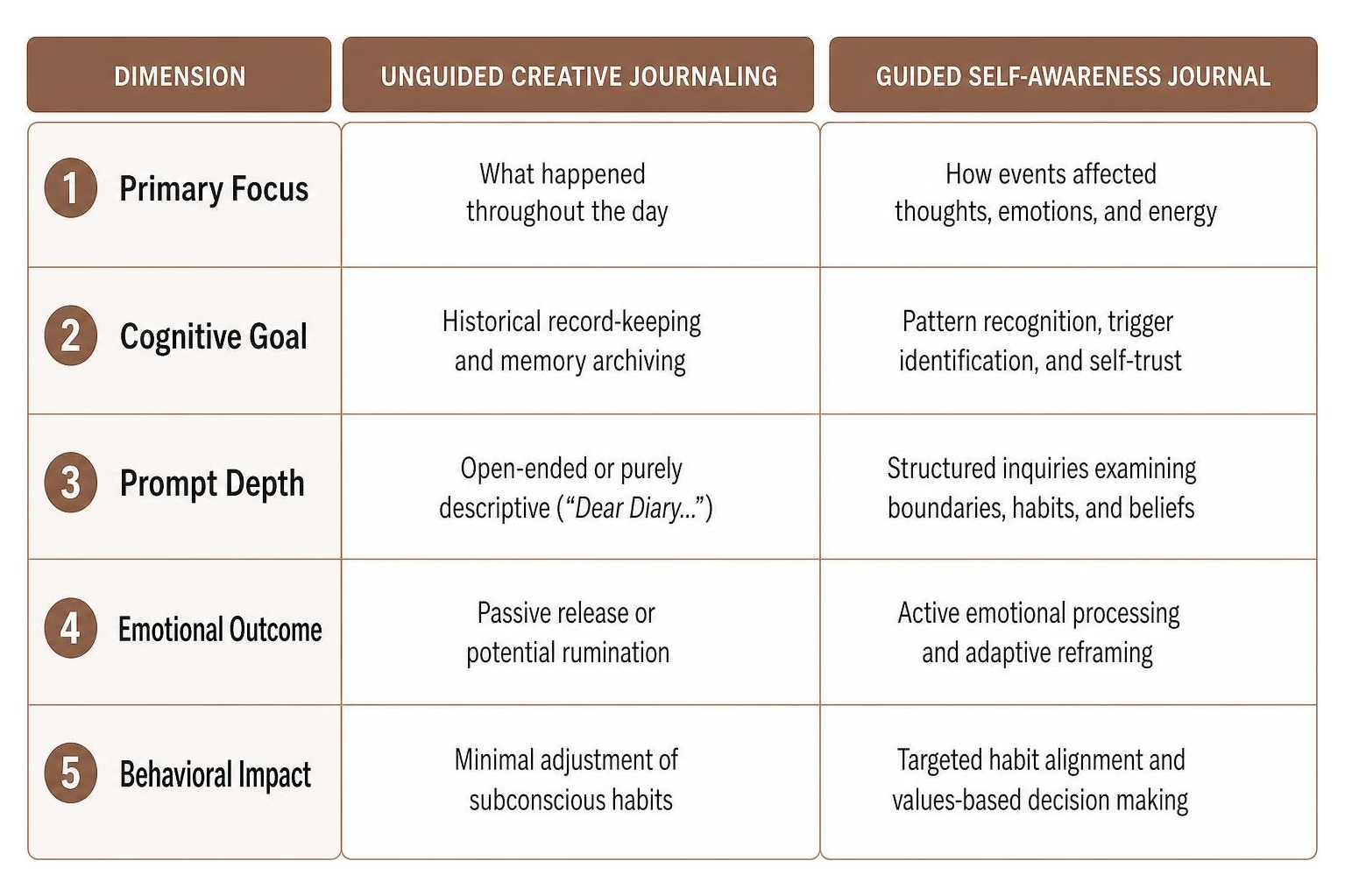
Many people abandon journaling because they confuse it with keeping a historical logbook. A standard diary documents events linearly: "Had lunch at noon, went to a presentation, finished three tasks." While accurate, this chronological recording does little to alter our internal state or uncover behavioral blind spots.
In contrast, reflective self-inquiry investigates the emotional context beneath those events.
| Dimension | Traditional Chronological Diary | Guided Self-Awareness Journal |
|---|---|---|
| Primary Focus | What happened throughout the day | How events affected thoughts, emotions, and energy |
| Cognitive Goal | Historical record-keeping and memory archiving | Pattern recognition, trigger identification, and self-trust |
| Prompt Depth | Open-ended or purely descriptive ("Dear Diary...") | Structured inquiries examining boundaries, habits, and beliefs |
| Emotional Outcome | Passive release or potential rumination | Active emotional processing and adaptive reframing |
| Behavioral Impact | Minimal adjustment of subconscious habits | Targeted habit alignment and values-based decision making |
By moving beyond simple logbooks to structured inquiry, you rewrite your narrative identity—transforming from a passive observer of stress into the conscious author of your habits.
Essential Reflection Formats and Selection Criteria
Choosing the right format for your journaling practice determines whether the habit lasts two weeks or becomes a lifelong anchor. The market offers thousands of journals—over 2,000 results populate online storefronts, ranging from bestsellers with tens of thousands of glowing reviews to specialized workbooks. To find what works for you, focus on functional structure rather than aesthetic hype.
Key Features to Look for in a Self Awareness Journal
When evaluating physical notebooks or digital templates, look for features that remove friction:
- Tiered Prompt Layouts: Effective journals offer a blend of micro-prompts for busy mornings and deeper long-form sections for unhurried evenings.
- Undated Formats: Dated journals create artificial guilt when you miss a few days. Undated pages allow you to pick up right where you left off without wasting paper.
- Integrated Checkpoints: Built-in habit check-ins, mood scales, and energy audits keep reflections grounded in real-world behavior rather than abstract philosophy.
- Dedicated Space for Mindset Shifts: Integrating a self-care affirmations journal into your routine helps you replace limiting self-talk with constructive beliefs.
- Physical or Digital Durability: If you prefer paper, look for heavy stock (100–120 GSM) that prevents ink bleed; if you prefer digital, prioritize zero-latency interfaces that work completely offline.
Comparing Guided and Unguided Reflection
Blank, unguided pages offer ultimate freedom, but they often lead to the dreaded "blank page paralysis." Guided journals solve this by providing research-backed frameworks that gently direct your attention toward productive self-inquiry.
For structured goal achievement and habit tracking, pairing narrative reflection with an offline daily weekly monthly habit tracker app allows you to track concrete behavioral metrics—like sleep, exercise, and hydration—alongside your written insights.
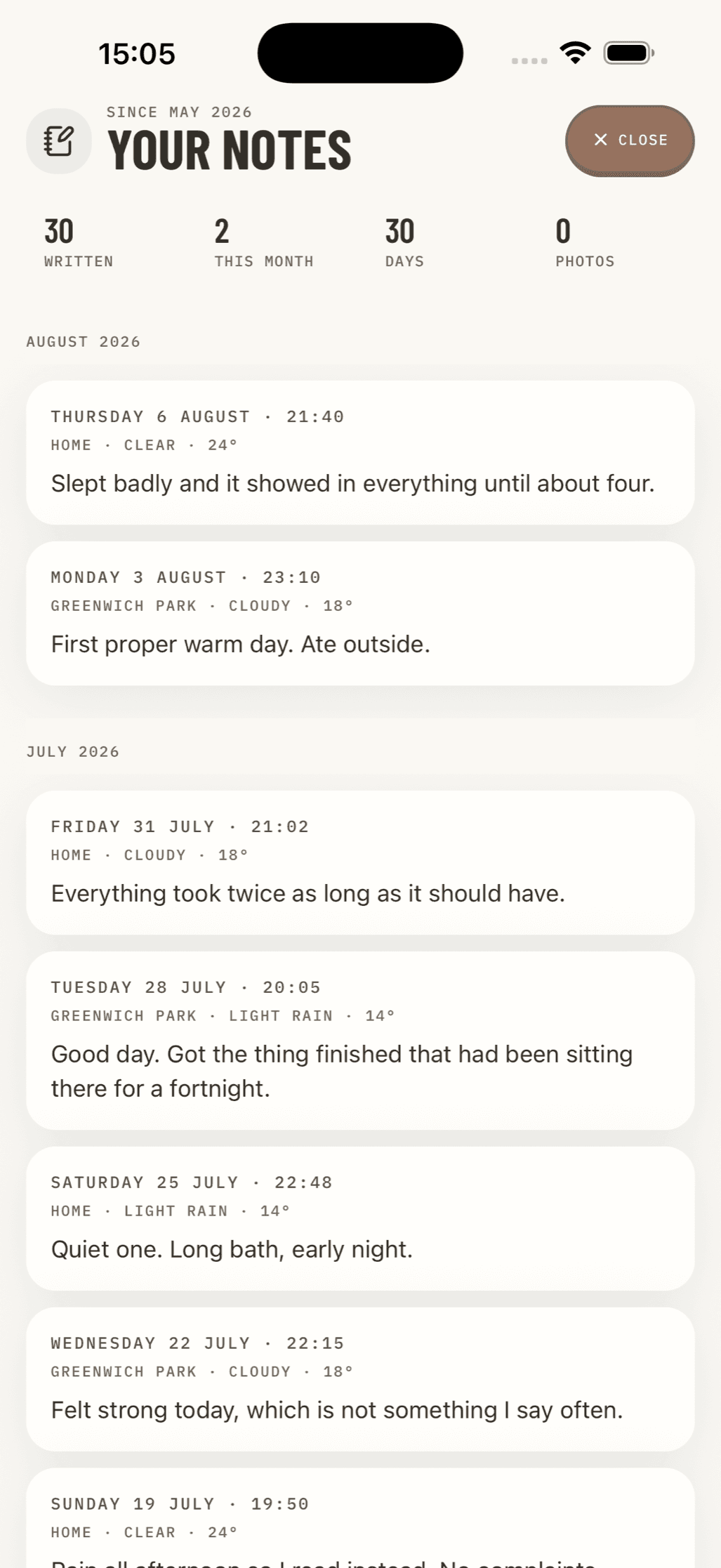
Whether you write in an analog notebook or type on your phone, privacy is non-negotiable. To be fully authentic on the page, you must know that your words are secure from prying eyes, corporate trackers, or cloud leaks. That is why choosing a tool that is private by design ensures you can write without self-censorship.
Tiered Reflection Prompts for Deep Inner Discovery
To avoid emotional fatigue, organize your journaling into three distinct time horizons: daily micro-check-ins, weekly alignment reviews, and monthly pattern audits.
Daily Check-Ins and Thought Pattern Prompts
Daily entries should take no more than 5 to 10 minutes. Use these morning and evening prompts to stay anchored:
- Morning Intention (3 minutes):
- What kind of person do I choose to show up as today?
- What are my 3 non-negotiable priorities for my energy?
- What subconscious trigger or autopilot habit must I watch out for today?
- Midday Awareness Reset (1 minute):
- Am I acting intentionally right now, or am I reacting on autopilot?
- Where am I holding physical tension in my body, and what does it need?
- Evening Reflection (5 minutes):
- What emotion did I experience most frequently today, and what sparked it?
- Which personal boundary did I honor, and which one slipped?
- What did I learn about my triggers or strengths today?
If you are logging these reflections digitally on your phone, dedicated notes and journaling tools provide a clean, distraction-free environment to archive your daily insights.
Weekly Reviews and Monthly Life-Alignment Prompts
Deeper growth requires zooming out to spot recurring themes. Once a week and at the close of every month, set aside 20 minutes to work through these structured inquiries, inspired by frameworks found in the Self-Discovery Journal and The Self-Concept Journal:
- Weekly Comfort-Zone Audit: Where did I operate inside my comfort zone this week, where did I stretch into healthy growth, and where did I slip into overwhelm? What small adjustment will restore balance next week?
- The Resource Allocation Check: If an impartial observer looked strictly at my calendar, screen time, and bank statements over the past 7 days, what would they say matters most to me? Does that match my stated values?
- The "Unspeakable First Draft" Prompt: Write for 5 minutes starting with the phrase: "The thing I am pretending not to know about my current situation is..." (Do not edit or polish your response).
- Monthly Limiting-Belief Review: What story did I tell myself this month that held me back? What concrete evidence from my real-world actions disproves this story?
- Rebuilding Self-Trust: What is one small, realistic promise I can make to myself for the next 30 days that I know I can keep without fail?

Building a Sustainable Habit of Inner Reflection
The greatest barrier to self-awareness is not a lack of profound thoughts—it is inconsistency. Building a daily journaling habit relies on behavioral design, not willpower.
The 30-Day Self Awareness Journal Challenge
To build momentum without burnout, commit to a structured 30-day progressive challenge:
- Days 1–7 (Emotional Baseline): Focus entirely on the 3-minute morning and evening emotional check-in. Record only your primary emotion, its potential source, and your immediate physical state. Keep it low-pressure.
- Days 8–14 (Trigger & Boundary Mapping): Begin logging moments of sudden friction, irritation, or anxiety. Note what happened right before the emotion surfaced and identify the underlying boundary that was tested.
- Days 15–21 (Cognitive Pattern Spotting): Start challenging recurring negative self-talk. Whenever you write down a self-limiting belief ("I always fail at consistency"), write down two objective facts that contradict it.
- Days 22–30 (Values & Future Alignment): Introduce weekly reviews and monthly prompts. Write a letter from your future self describing how handling current challenges with clarity changed your trajectory.
If you miss a day, simply pick back up the next morning without attempting to "backfill" missed entries. Consistency is about frequency over time, not an unbroken streak.
Overcoming Resistance and Avoiding Over-Introspection
Self-reflection can occasionally veer into unproductive rumination. When we obsess over our flaws or over-analyze every fleeting emotion, our stress levels rise rather than fall.

To keep your journaling healthy and grounded, adopt the mindset of a compassionate, objective scientist:
- Adopt the "No One Will Ever Read This" Rule: If you catch yourself writing performatively—polishing sentences as if an audience might judge them—pause and remind yourself that raw honesty is the only currency that matters here.
- Balance Reflection with Action: Always conclude deep journaling sessions with a concrete, real-world action: "Now that I recognize this trigger, the single boundary I will set today is..."
- Separate Identity from Emotion: Instead of writing "I am an anxious mess," reframe your entry as "I am noticing the sensation of anxiety in my chest right now." That subtle shift creates the mental space needed for emotional regulation.
Frequently Asked Questions About Journaling for Self-Awareness
How does a self-awareness journal differ from a standard daily planner?
A standard daily planner is an external organization tool designed to manage schedules, deadlines, and task lists. It focuses on productivity: what needs to get done and when.
A reflective journal is an internal exploration tool. It examines why you react the way you do, evaluates your energy levels, and identifies recurring behavioral patterns. While a planner organizes your day, an introspection journal organizes your mind.
How much time each day is required to see noticeable mental health benefits?
You do not need to write for an hour to experience meaningful results. Clinical research on expressive writing and emotional regulation shows that spending just 5 to 15 minutes a day of focused, honest reflection produces measurable reductions in stress and anxiety. Consistency matters far more than session length.
What should you do when journaling uncovers uncomfortable emotions?
It is completely normal for deep reflection to surface buried frustration, grief, or uncomfortable truths about relationships and habits. When this occurs, avoid the urge to close the journal immediately or judge yourself for feeling that way.
Acknowledge the realization by writing: "I am not obligated to solve or fix this today, but I am willing to sit with it honestly." If an entry surfaces deep emotional trauma, pair your personal journaling practice with the guidance of a licensed therapist or mental health professional.
Conclusion
Developing true emotional clarity is not an overnight transformation. It is a quiet, daily discipline of noticing what is happening beneath the surface, questioning our automatic assumptions, and aligning our everyday actions with what we genuinely value.
Whether you write in a leather-bound notebook or log quick, encrypted reflections on your iPhone, the secret lies in building a private, secure space where you can be entirely honest with yourself. If you are looking for an offline, privacy-first companion to log your daily thoughts, track your health metrics, and preserve your personal insights without accounts or tracking, explore our Nama wellness tracking features to support your personal growth journey.