Transform Your Living Room Fitness Routine with a Dedicated Home Exercise Log
Build Consistency With a Home Exercise Log
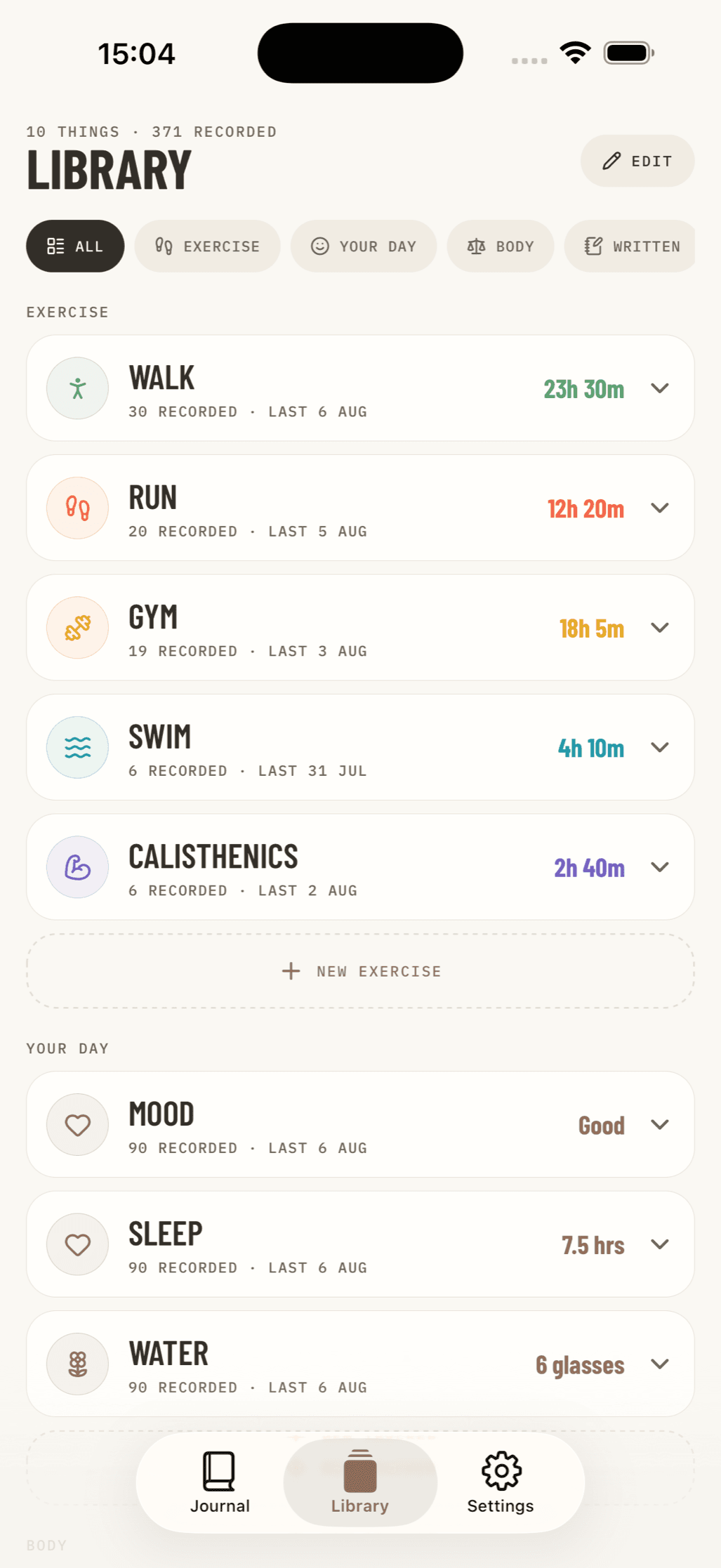
A home exercise log helps you follow through on living room workouts by making each session clear and visible. Keep it simple: plan this week's workouts, record what you actually did right after each session, then review the page once a week.
For each workout, write down:
- The date and workout type
- Exercises, sets, reps, weight, or minutes
- How hard it felt and any discomfort
- One recovery note, such as sleep, steps, water, or energy
This small habit turns vague intentions into useful feedback. You can see that you completed two sessions by Wednesday, notice that Friday workouts rarely happen, or spot that a movement bothers your knee. That is practical accountability without alerts, ads, social feeds, or cloud sharing.
At-home fitness often breaks down because deciding what to do feels like another task. A dedicated log reduces that decision fatigue: your plan tells you what is next, and your record shows what is working. At Nama, we believe private, honest tracking can make a modest routine easier to sustain than chasing a perfect streak.
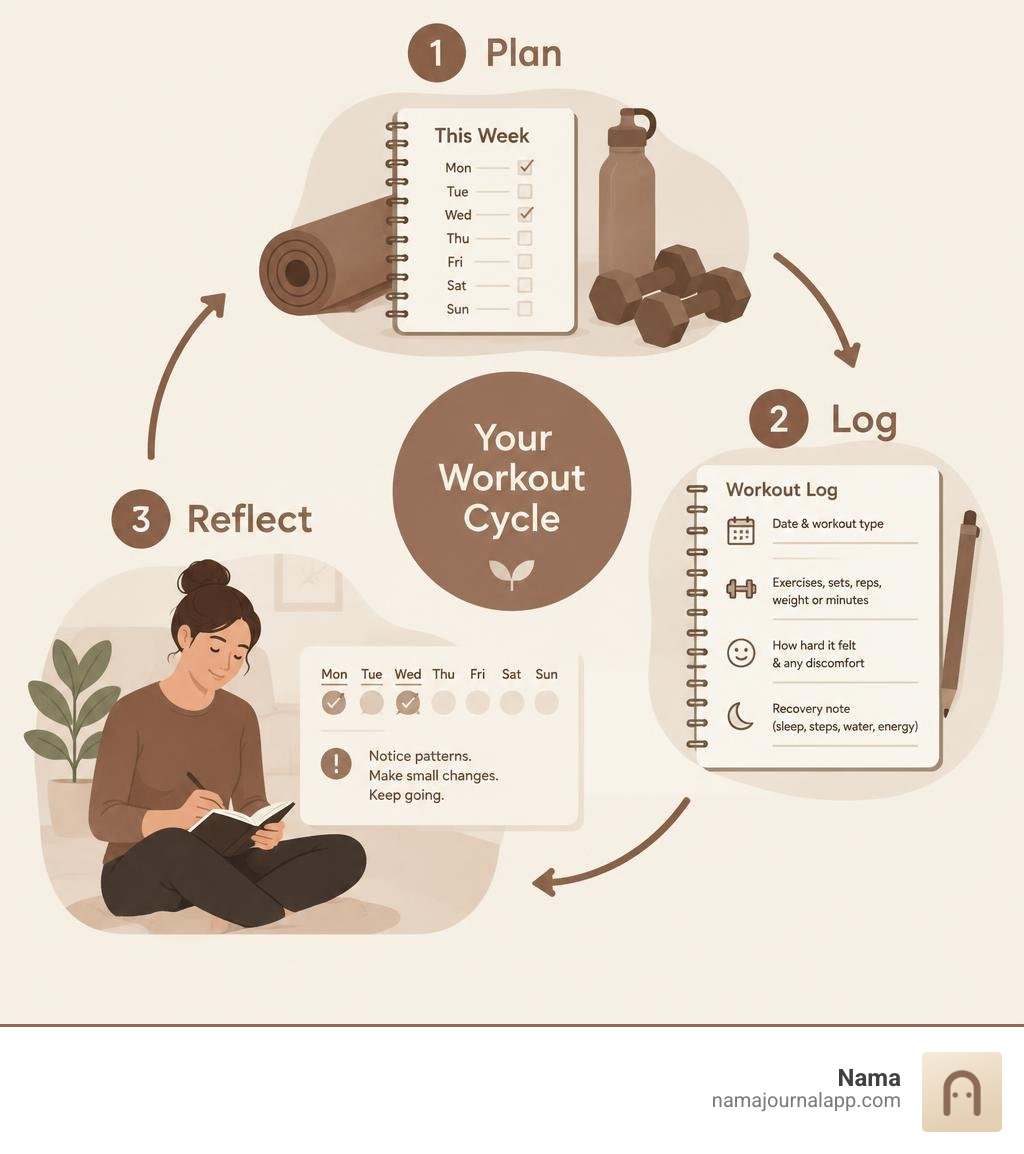
Basic home exercise log vocab:
For broader context on how self-monitoring supports behavior change, see the self-monitoring research overview.
Why a Dedicated Home Exercise Log Transforms Living Room Fitness
When training at home, the boundary between rest and effort blurs. The couch sits ten feet from your yoga mat, laundry sits in your peripheral vision, and no front-desk staff checks your badge. In this environment, consistency rarely fails due to a lack of willpower; it fails because of a lack of clarity.
Behavioral science shows that self-monitoring is one of the most effective tools for establishing lasting habits. Recording a behavior alters your relationship to that behavior before any complex program design takes effect. When you track what you do, you create a feedback loop that transforms abstract effort into tangible evidence.
The World Health Organization (WHO) structures its physical activity recommendations across an entire week rather than demanding rigid perfection every single day. The guidance focuses on accumulating moderate-to-vigorous movement minutes alongside targeted muscle-strengthening work across multiple days. A dedicated training log aligns with this reality by shifting your perspective from single-day pass/fail tests to cumulative weekly volume.
Keeping an exercise journal creates genuine self-accountability. When your log shows two solid workouts completed by Wednesday afternoon, you feel quiet momentum. You do not need aggressive push notifications, gamified badges, or public leaderboards to stay engaged. The work speaks for itself through your own entries.
Forward Planning vs. Backward Logging: How They Work Together
A common point of confusion is the difference between a workout planner and an exercise log. While related, they serve two distinct functions that complement each other:
- The Workout Planner (Looking Forward): Sets your intention. It answers logistical questions before you start sweating: Which days will you train? Will you focus on lower-body strength, mobility, or conditioning? Pre-selecting your routine removes mid-workout hesitation and decision fatigue.
- The Exercise Log (Looking Backward): Acts as your record of truth. It captures what actually occurred: the weight lifted, the repetitions completed, the minutes moved, and how your body responded to the load.
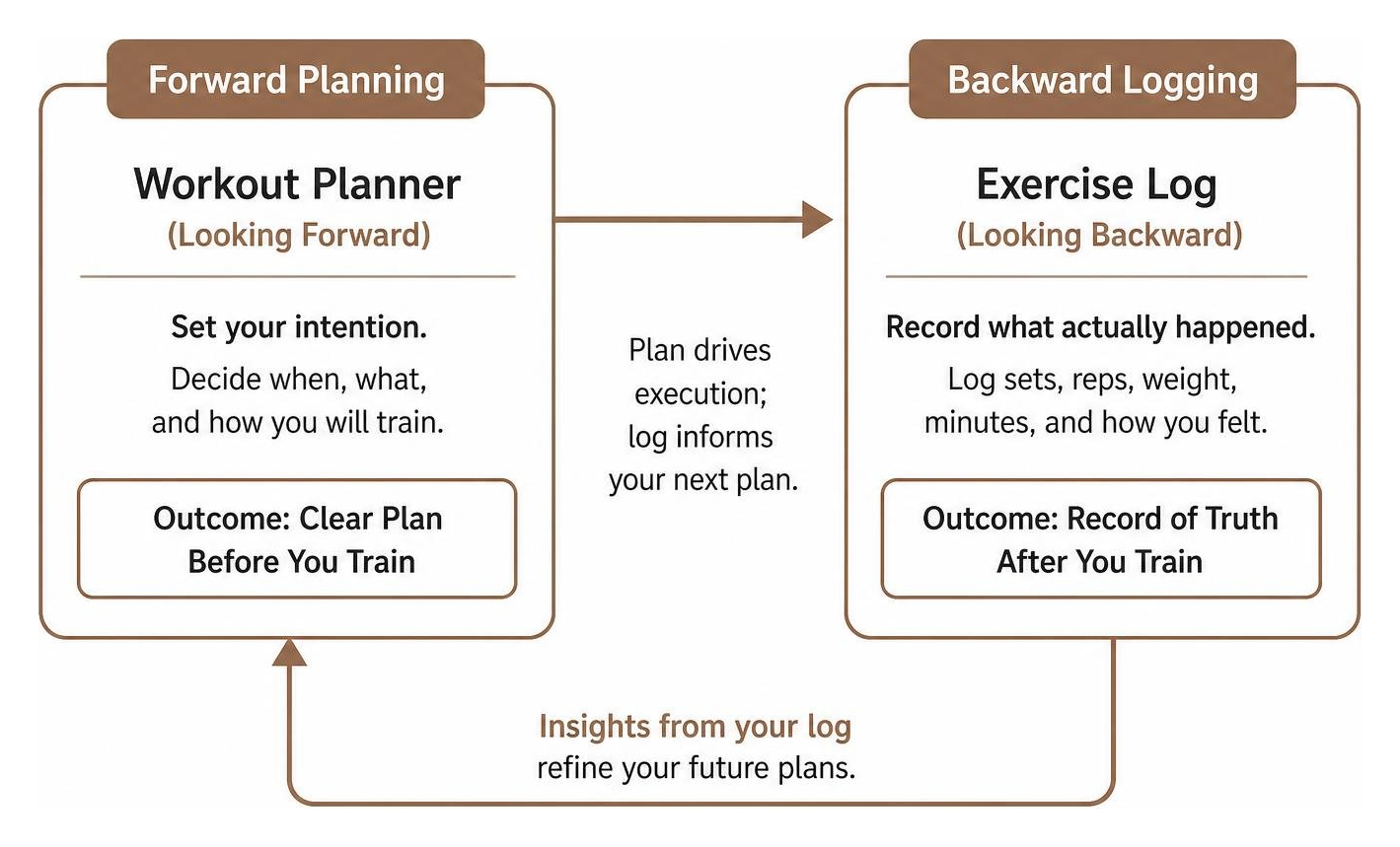
Using these tools together creates a sustainable structure. If your planner outlines a 30-minute dumbbell circuit for Tuesday morning, your log records whether you finished all three sets or stopped early due to shoulder fatigue. Incorporating practical weekly exercise log tips for 2026 helps you manage these insights in manageable blocks. Organizing your training into 40-session blocks provides enough historical data to highlight clear strength trends without overwhelming you with data management.
Core Data Points for Your Home Exercise Log
A useful training log balances thoroughness with low friction. If entering your workout details takes longer than your warm-up, you will quickly abandon the practice. Focus on capturing the core variables that drive physical adaptations:
- Date and Time: Establishes context and highlights your natural training rhythms.
- Exercise Selection: The specific movement performed (such as Romanian deadlifts, push-ups, or goblet squats).
- Volume and Load: The completed sets, repetitions, and resistance used (body weight, resistance band tension, or dumbbell poundage).
- Rate of Perceived Exertion (RPE): A simple 1-to-10 subjective scale indicating how close you were to muscular failure.
- Session Duration: Total active training time, excluding extended rest periods or distractions.
- Qualitative Feedback: One or two sentences detailing joint comfort, energy levels, or technical improvements.
Applying structured bodybuilding workout tracker methods allows you to systematically apply progressive overload. By comparing your current session with past entries, you can determine when to add an extra repetition, shorten rest intervals, or increase resistance safely.
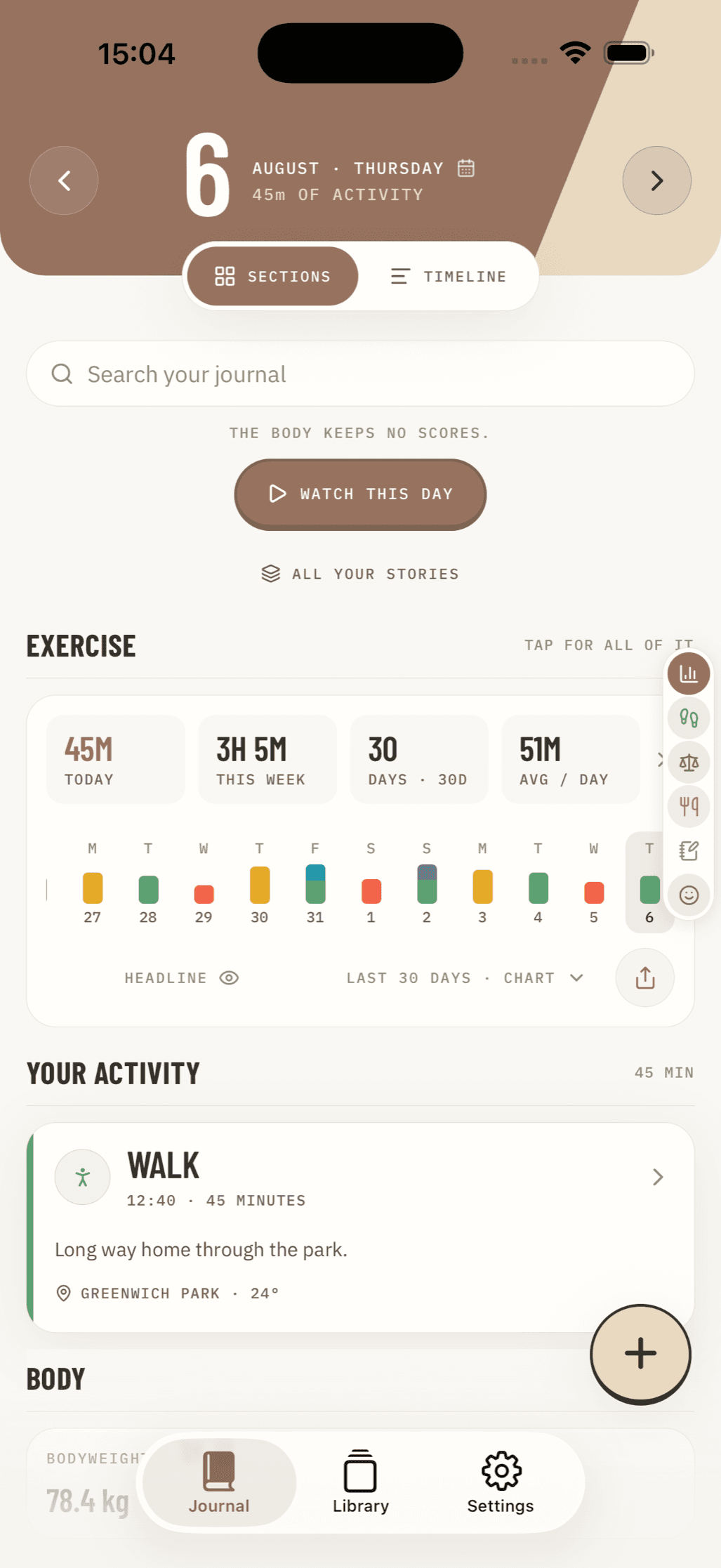
Essential Elements to Track Alongside Your Training
Living room training does not exist in a vacuum. Your ability to recover, build strength, and maintain joint health depends heavily on your daily recovery habits. Integrating essential lifestyle markers directly into your training log provides a complete picture of your physical capacity.
Holistic Recovery Metrics: Sleep, Nutrition, and Daily Movement
Tracking secondary wellness markers alongside your sets and reps highlights why certain sessions feel effortless while others feel sluggish.
- Sleep Duration and Quality: Aiming for 7 to 9 hours of restorative sleep directly influences central nervous system recovery, force output, and tissue repair.
- Daily Step Counts: Non-exercise activity thermogenesis (NEAT) keeps joints lubricated and burns passive energy. Accumulating 5,000 to 10,000 daily steps complements focused home strength sessions.
- Hydration: Maintaining fluid intake (often around half your body weight in ounces per day as a baseline) prevents premature muscular cramping and mid-workout fatigue.
- Protein Intake: Consuming adequate dietary protein (frequently targeted around 0.7 to 1.0 grams per pound of lean body weight for active individuals) provides the raw materials necessary to repair muscle fibers broken down during home workouts.
Reviewing actionable free exercise log tips for 2026 can help you combine these lifestyle variables into a streamlined, one-page daily check-in.
| Metric Type | Primary Focus | Target Metric | Impact on Home Workouts |
|---|---|---|---|
| Primary Training | Progressive Overload | Sets, Reps, Weight, RPE | Stimulates muscle adaptation and strength |
| Primary Training | Cardiovascular Health | Sustained Aerobic Minutes | Improves recovery rate between intense sets |
| Recovery Habit | Neuromuscular Repair | 7–9 Hours Sleep | Restores baseline force production and focus |
| Recovery Habit | Baseline Activity | 5,000–10,000 Steps | Enhances circulation without adding systemic fatigue |
| Recovery Habit | Tissue Hydration | 64–100 oz Water | Maintains blood volume and muscle contractility |
| Recovery Habit | Muscle Protein Synthesis | 0.8–1.0g per lb Target | Accelerates recovery and minimizes delayed soreness |
Spotting Patterns and Preventing Workout Plateaus
The real value of logging workouts appears after several weeks of continuous recording. Reviewing your log helps you spot subtle trends that might otherwise go unnoticed:
- Identifying Chronic Missed Days: If your log reveals that Thursday evening workouts are consistently skipped due to work fatigue, you can proactively move that session to Saturday morning.
- Monitoring Joint Discomfort: If a specific movement—like deep reverse lunges—consistently causes knee discomfort across three entries, your log alerts you to adjust your stance, reduce the load, or swap the movement for a box step-up before an acute injury occurs.
- Detecting Stagnant Loads: If you have used the same 15-pound dumbbells for dumbbell floor presses across twelve consecutive sessions with an RPE of 6, your log clearly signals that it is time to progress the movement.
- Evaluating Warm-Up Needs: Noting that your hips feel tight during the first two sets of squats reminds you to dedicate five minutes to dynamic hip mobility before your next lower-body session.
Choosing Your Digital Home Exercise Log
While paper notebooks offer a tactile way to track workouts, many people prefer digital tools for easier history searching, organized sorting, and long-term storage. However, many modern fitness apps have become cluttered with mandatory cloud profiles, social feeds, unsolicited community challenges, and continuous subscription popups that pull your focus away from training.
When selecting a digital tracker, prioritize tools that make data entry fast, operate reliably offline, and respect your personal privacy.
Choosing the Right Digital Home Exercise Log
A well-designed digital log should reduce friction, not introduce it. When evaluating logging software, look for these practical features:
- Fast Entry Workflows: The interface should let you record sets, reps, and notes in under thirty seconds while your heart rate is still elevated.
- Complete Offline Functionality: Your workout data should live directly on your device, allowing you to log workouts seamlessly in your basement, garage, or while traveling without an active internet connection.
- Local Data Privacy: Your personal wellness metrics, workout notes, and progress photos should belong entirely to you, safely isolated from remote corporate servers or ad networks.
- Visual Progress Indicators: Simple delta indicators (such as showing whether your resistance or volume increased compared to the previous entry) provide immediate clarity on your progress.
- Flexible Note Fields: Dedicated space for qualitative observations lets you track lifestyle context, energy levels, and movement comfort alongside raw numbers.
To explore options across digital and analog formats, check out our workout tracker app guide for 2026 for practical tips on structuring your daily entries.
Setting Sustainable Weekly Workout Targets
A common pitfall in living room fitness is building a routine that is too ambitious to maintain. Starting with a rigid schedule of six high-intensity workouts a week often leads to burnout, excessive soreness, and dropped habits by week three.
Instead, build your routine around sustainable baselines:
- Commit to a 3-Day Strength Foundation: Schedule three focused 30-to-45-minute full-body sessions per week, with at least one recovery day between them. This leaves room for life's unexpected interruptions while stimulating the major muscle groups (legs, push, pull, and core).
- Accumulate Daily Movement Minutes: Follow health guidelines by aiming for active movement daily. This does not require formal training gear; brisk neighborhood walks, family bike rides, or brief mobility flows all contribute to your weekly volume.
- Schedule Active Recovery: Dedicate your non-lifting days to light stretching, focused mobility work, or low-intensity cardio to encourage tissue recovery without adding systemic stress.
- Prioritize Consistency Over Intensity: Completing three modest, well-documented sessions every week for six months will always yield better results than alternating between two weeks of extreme effort and three weeks of complete inactivity.
Frequently Asked Questions About Home Workout Logs
What should I write in my workout log after each session?
Keep your post-workout entry concise so it remains a sustainable habit. We recommend a simple three-line format that takes less than thirty seconds to complete:
- Line 1 (The Movement Focus): Note the primary muscle groups or training style (for example, Upper Body Strength & Core or Lower Body Mobility).
- Line 2 (The Work Completed): List your core exercises along with the completed sets, reps, and resistance used (such as Goblet Squats: 3x10 @ 35 lbs; Push-ups: 3x12 @ Bodyweight; Dumbbell Rows: 3x10 @ 25 lbs).
- Line 3 (The Subjective Reflection): Write one honest sentence about how the session felt (for example, Energy was high, but left shoulder felt slightly tight during final push-up set; warm up longer next time).
Do I need to log every single stretch and warm-up?
No. Your exercise log should be a practical tool, not a bureaucratic chore. Logging rewards honesty and actionable insight rather than exhaustive detail.
Focus your detailed tracking on primary strength movements, loaded resistance exercises, and dedicated conditioning blocks where tracking progressive overload matters. For dynamic warm-ups, quick hamstring stretches, or casual walks around your neighborhood, a simple checkmark or brief summary note (such as 10-minute full-body mobility flow completed) is plenty. Keep your logging energy focused on the data points that directly shape your future training decisions.
How often should I review my exercise log to make adjustments?
Set aside five minutes at the end of every week to review your recent entries. This weekly check-in bridges the gap between your forward plan and your recorded results:
- Check Completed Frequency: Compare the workouts you planned against the workouts you actually logged. If you consistently miss a specific day, adjust your schedule to match your natural weekly rhythms.
- Assess Progressive Overload: Look back over the past two to three weeks for each core movement. If your reps and resistance have remained unchanged while your perceived exertion has dropped, plan small load increases for the upcoming week.
- Review Fatigue and Pain Patterns: Look for recurring notes about joint stiffness, poor sleep, or lingering soreness. Use these clues to add warm-up drills, modify exercise angles, or schedule an extra active recovery day.
Conclusion
Transforming your living room into an effective, long-term training space does not require expensive gym machines or complex programming. It simply requires clarity, honest feedback, and steady consistency.
A dedicated training log bridges the gap between your fitness intentions and daily execution. By planning your workouts ahead of time, recording what you actually do, and tracking essential recovery habits like sleep and hydration, you create a sustainable fitness routine built on real progress.
If you prefer a clean, private, and distraction-free mobile workflow, explore our offline privacy-focused exercise log. At Nama, we design tools that keep your personal wellness data entirely on your iPhone—free from accounts, remote cloud databases, social feeds, and intrusive tracking. Choose your training movements, log your first session today, and let your own progress keep you showing up.