Find the Best Calorie and Step Tracker to Match Your Lifestyle
How Activity Tracking Hardware and Software Measure Daily Movement

The best calorie and step tracker depends on your routine and priorities: smartwatches offer the most comprehensive GPS and optical heart rate metrics for active training, fitness bands deliver lightweight form factors with multi-day battery life, and smartphone apps provide accessible, zero-cost tracking with high data privacy.
Whether you rely on a high-end GPS smartwatch or an accurate calorie counter on your phone, every device starts by capturing raw physical motion. When you walk, run, or climb stairs, micro-electro-mechanical systems (MEMS) inside your hardware measure changes in velocity and orientation across three dimensions. The software takes those continuous electrical signals, filters out background noise, and converts them into steps, distance, active minutes, and estimated energy expenditure.
Step Counting Mechanics and Sensor Fusion
Modern wearables and smartphones do not simply count every bump or vibration as a step. If they did, brushing your teeth, typing on a mechanical keyboard, or driving over a pothole would artificially skyrocket your daily score.
To deliver reliable numbers, devices rely on sensor fusion—combining data from a 3-axis accelerometer and a gyroscope:
- 3-Axis Accelerometer: Measures acceleration along the X, Y, and Z axes to detect rhythmic up-and-down and forward motion patterns characteristic of human gait.
- Gyroscope: Measures angular velocity and rotation, helping the algorithm understand your arm swing angle or phone orientation.
- Filtering Algorithms: Peak-detection algorithms look for regular thresholds in wave amplitude and frequency. If a motion does not match human walking cadence (typically 1.5 to 2.5 steps per second), the algorithm discards it.
- Stride Length Calibration: Distance is calculated by multiplying your total steps by your estimated stride length, which is based on your height, biological sex, and cadence—or refined via GPS tracking during outdoor walks and runs.
In real-world field tests, step counts remain remarkably consistent across major brands. When tested against manual counts over extended distances, devices with accelerometer and gyroscope fusion stay within a 5% margin of error.
Heart Rate Monitoring and Calorie Burn Calculations
While counting steps is relatively straightforward, calculating caloric expenditure is far more complex. Your body burns energy in two primary ways:
- Basal Metabolic Rate (BMR): The baseline calories your body burns at complete rest just to keep your organs functioning. This makes up 60% to 75% of your total daily burn and is estimated using standard formulas based on your age, biological sex, height, and weight.
- Active Calories: The additional energy expended through physical movement, exercise, and daily tasks.
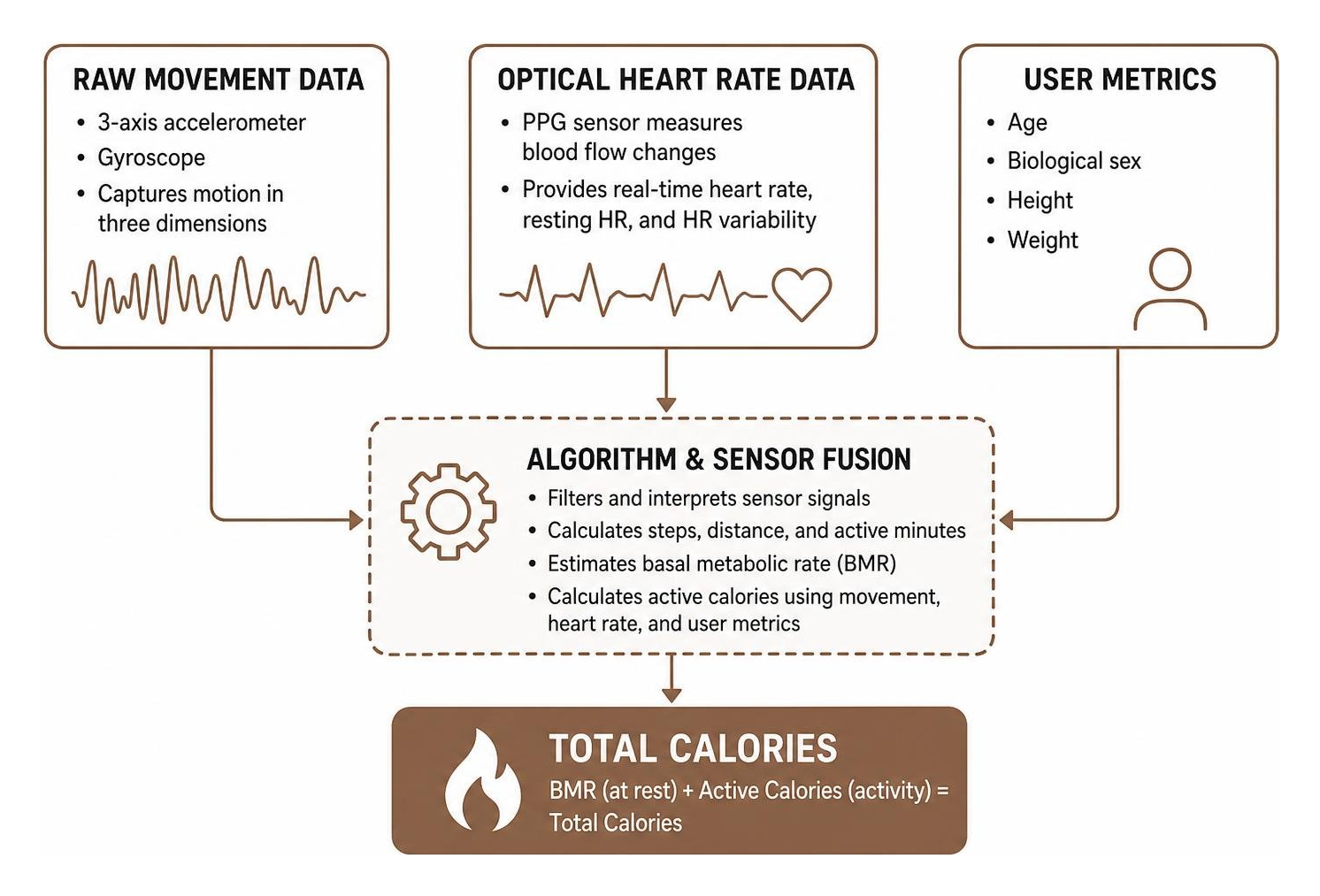
To calculate active calories, basic step trackers rely on Metabolic Equivalent of Task (MET) values, multiplying movement duration and speed by your body mass. However, MET formulas assume everyone burns energy identically during a brisk walk.
This is where continuous optical photoplethysmography (PPG) sensors make a major difference. Optical sensors flash green LED lights against your skin to measure blood flow changes through expanding capillaries. A good calorie tracker app or dedicated wearable uses your real-time heart rate alongside resting heart rate and heart rate variability (HRV) to assess true physiological strain.
When you transition from a casual stroll to high-intensity interval training (HIIT), your heart rate spikes long before your step count reflects the increased effort. Devices with reliable heart-rate tracking can therefore provide far more realistic active burn trends during non-stepping activities like cycling, rowing, or weightlifting.
How to Choose the Best Calorie and Step Tracker for Your Needs
Selecting the ideal tracker comes down to matching your daily habits, training style, and privacy preferences against hardware capabilities and software ecosystems.
| Tracker Category | Best For | Typical Battery Life | Step Accuracy | Calorie Reliability | Privacy & Offline Use |
|---|---|---|---|---|---|
| Smartwatches | Comprehensive fitness, GPS maps, rich training metrics | 1 to 14 days | Excellent | High (advanced HR algorithms) | Cloud-dependent, requires account |
| Fitness Bands | Slim daily wear, set-and-forget step and sleep tracking | 7 to 14 days | Excellent | Moderate to High | Cloud-dependent, vendor ecosystem |
| Screenless Bands / Rings | Low distraction, 24/7 recovery and strain coaching | 4 to 7 days | Good to Very Good | Moderate to High | Subscription or cloud-centric |
| Hybrid Watches | Classic analog style with hidden tracking sensors | Up to 35 days | Very Good | Moderate | Cloud sync required |
| Mobile Pedometer Apps | Zero extra hardware, phone-in-pocket daily tracking | Uses phone battery (negligible) | Good (when phone is carried) | Moderate (movement-based) | High (offline options, local storage) |
Whether you want an all-in-one wearable or prefer a lightweight digital tool to track anything manually, understanding the core hardware and software trade-offs will help you make the right investment.
Why Wearable Hardware Matters for the Best Calorie and Step Tracker
Dedicated wearables hold a distinct advantage: they remain anchored to your body all day and night.
- Continuous Contact: A wrist-worn tracker captures every kitchen trip, hallway stroll, and chore that you might miss if your phone is resting on a desk.
- Sensor Variety: Premium wearables pack specialized sensor suites, including multi-wavelength optical HR arrays, skin temperature sensors, electrocardiograms (ECG), and electrodermal activity (EDA) sensors for stress detection.
- Durability and Water Resistance: With 5ATM or IP68 water resistance ratings, modern bands survive lap swimming, heavy sweat, and showers without issue.
- Battery Life Diversity: Options range from full-featured smartwatches requiring daily charging to power-efficient fitness bands with roughly one to two weeks of battery life and hybrid watches that can last several weeks on a single charge.
The primary limitation of wearable hardware is ecosystem lock-in and mandatory cloud accounts. Many popular wearables upload your biometric data directly to remote servers, with some platforms locking advanced historical trends, sleep profiles, and recovery insights behind paid subscriptions.
What Makes a Smartphone App the Best Calorie and Step Tracker
If you prefer not to wear extra hardware on your wrist, your smartphone is already equipped with powerful motion-sensing hardware.
Modern smartphones feature dedicated low-power motion coprocessors that track physical movement continuously in the background without draining your battery. When paired with a reliable daily weekly monthly habit tracker app, your phone becomes an effortless, cost-effective activity logger.
Smartphone tracking shines in several areas:
- No Extra Cost: You do not need to spend $100 to $500 on hardware that becomes obsolete in a few years.
- Total Convenience: Your phone is already in your pocket during daily commutes, grocery runs, and neighborhood walks.
- Data Ownership and Privacy: Standalone mobile pedometers can run entirely offline, avoiding mandatory account creation, continuous cloud syncing, and third-party data tracking.
Wearables vs. Dedicated Smartphone Pedometer Apps
Deciding between a wrist wearable and a mobile pedometer depends on how and where you move throughout the day.
When it comes to pure step counting, both options are remarkably accurate under the right conditions. A wrist tracker counts movement whenever you are on your feet, but it can occasionally register false steps during activities with heavy arm motion (like folding laundry or chopping vegetables). Conversely, a smartphone only tracks steps when it is physically on your body; steps taken while your phone sits on your nightstand are simply lost.
For nutrition and energy balance, syncing your step data alongside a private food diary helps you see the direct relationship between your daily fuel and total physical output.
Standalone Mobile Pedometers for Smartphones
If you choose the mobile route, native smartphone hardware provides clean, battery-efficient tracking without unnecessary bloat:
- iOS Motion Coprocessor Tracking: Using the built-in motion hardware on compatible devices, native pedometer tools track daily steps, estimated active calories, distance, active time, and floors climbed. Because they operate using passive hardware sensors rather than active GPS polling, they preserve battery life and can store movement trends locally on device.
- Hardware Sensor Pedometers: On compatible smartphones, standalone sensor-based pedometers utilize built-in step detector and step counter sensors rather than continuous GPS tracking. These tools function completely offline without mandatory accounts, provide customizable motion sensitivity settings, and allow direct local data management.
Calorie Tracking Accuracy and Common Pitfalls
Regardless of whether you use a sports watch or a free phone app, calorie burn metrics must be interpreted carefully. Wearable calorie expenditure algorithms carry a standard margin of error ranging from 15% to over 30%, depending on the activity type.
Here are the most common pitfalls to keep in mind:
- The "Eating Back Calories" Trap: Because wearables tend to overestimate active burn during moderate cardio and steady-state walking, eating back every calorie reported by your device can stall weight loss progress.
- Strength Training Discrepancies: Optical heart-rate monitors struggle during heavy lifting because wrist flexing constricts blood vessels, leading to delayed or inaccurate HR readings.
- Static Basal Metrics: If you lose or gain weight but forget to update your personal profile in your tracking app, your daily BMR calculation will become increasingly inaccurate over time.
- Wrist Motion Noise: Pushing a shopping cart, holding a stroller, or carrying grocery bags keeps your wrist static, causing some wearables to undercount steps even while you are actively walking.
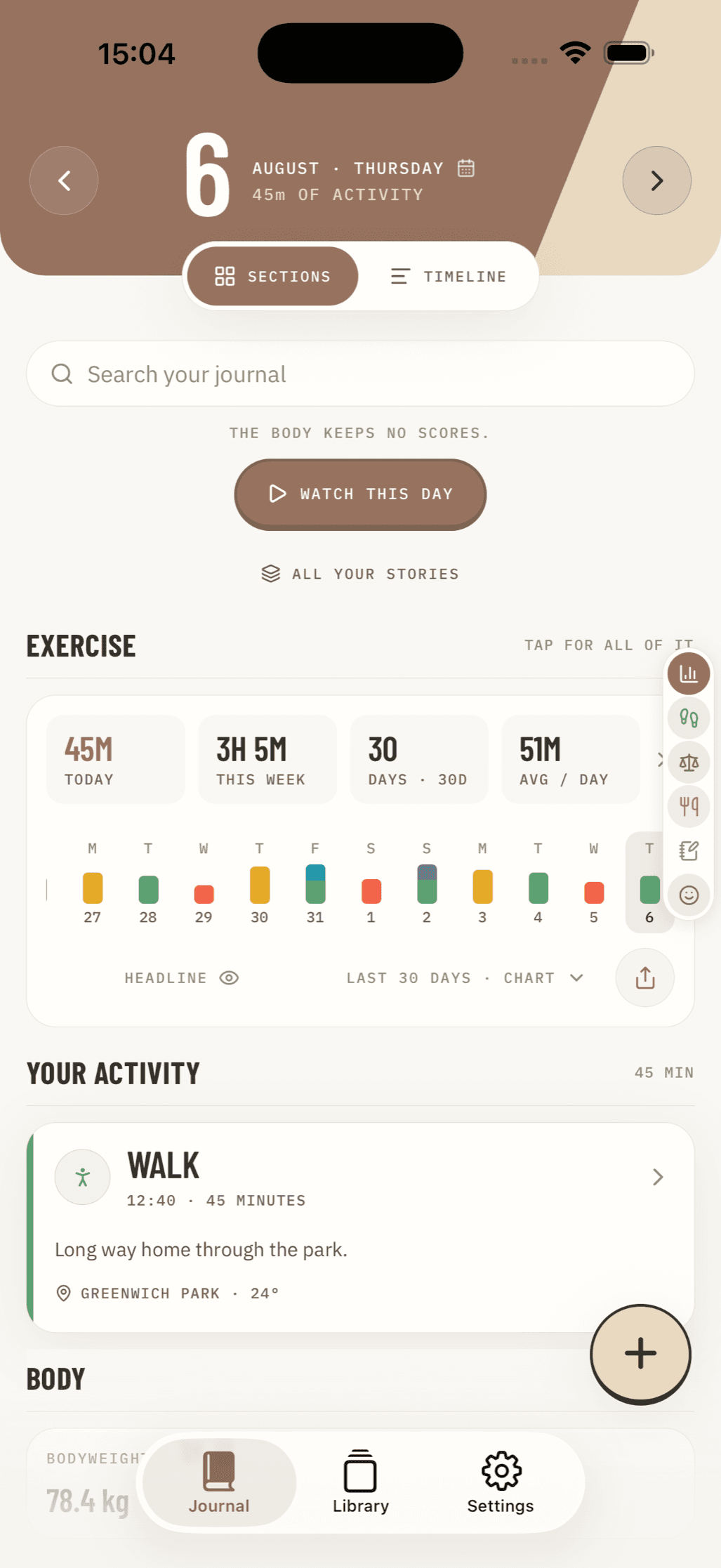
Logging your strength workouts, cardio sessions, and daily reflections in a dedicated exercise journal allows you to focus on performance milestones and strength gains rather than stressing over estimated calorie burns.
Frequently Asked Questions About Calorie and Step Counting
How accurate are calorie burn estimates on fitness trackers?
Calorie burn figures on fitness trackers and smartwatches are statistical estimates, not direct metabolic measurements. Direct measurement requires laboratory equipment (such as indirect calorimetry masks that analyze oxygen consumption and carbon dioxide output).
Wearables estimate burn using mathematical formulas that combine your user profile (age, sex, height, weight) with movement cadence and heart-rate data. While they are useful for comparing relative workout intensity from day to day, they should not be treated as exact scientific data.
Do phone pedometer apps drain battery quickly?
No, provided you choose an app that uses built-in hardware step counters rather than continuous GPS tracking. Modern smartphones include dedicated motion coprocessors designed to process accelerometer signals using minimal power. Standalone pedometer apps rely on these passive background sensors, consuming a negligible fraction of your daily battery life.
Can you track steps and calories accurately without a subscription?
Yes. While subscription services can provide in-depth recovery modeling and strain scores, core step counting and calorie estimation do not require a recurring fee.
Many non-subscription wearables and standalone mobile pedometers deliver reliable daily tracking, distance calculations, and workout logging without recurring subscription costs.
Conclusion
Finding the right tool to measure your daily movement comes down to what fits seamlessly into your lifestyle. A dedicated wrist tracker offers continuous biometric monitoring and workout heart-rate tracking, while a streamlined mobile pedometer provides hassle-free step counts without extra hardware or battery drain.
Tracking your movement is most powerful when it supports your long-term wellness without adding digital stress or compromising your personal information. If you want a private, mindful way to document your daily activity, workouts, and nutrition, Nama offers a completely offline, privacy-first wellness journal. With no accounts, no cloud tracking, and full data export capabilities, you can maintain an intentional exercise log and health history entirely on your own terms.