Why Writing in a Daily Self Care Journal Boosts Your Mood
How to Start a Daily Self Care Journal Habit

Start a daily self care journal with five minutes at a time. Write how you feel, note what your body needs, and choose one small act of care for today. Pair the check-in with a routine you already have, like morning tea. If you miss a day, simply start again.
Putting feelings into words can help you spot patterns and decide what to do next. Your entries do not need to be long or upbeat to be useful.

Daily self care journal vocabulary:
The Science Behind Why a Daily Self Care Journal Improves Well-Being
Setting pen to paper—or capturing private notes digitally—does much more than organize our schedules. It physically reshapes how our brains process emotional tension and everyday stress.
A 2021 study revealed that humans show significantly stronger brain activity and memory recall after physically writing things down. Writing recruits neural circuitry involved in spatial processing and linguistic encoding, grounding abstract worries into concrete realities.
Furthermore, a comprehensive 2022 clinical study highlighted that expressive writing acts as a low-cost, low-side-effect therapeutic practice that directly aids in managing symptoms of anxiety, traumatic stress, and PTSD. By practicing expressive writing, we initiate neuroplastic changes that help dismantle chronic fight-or-flight loops.
You can explore a scientific video guide on journaling for mental wellness to see how visual layouts support mental decompression. Combining structured reflection with an intentional self-awareness journal gives our minds a structured container to process thoughts rather than endlessly ruminating.
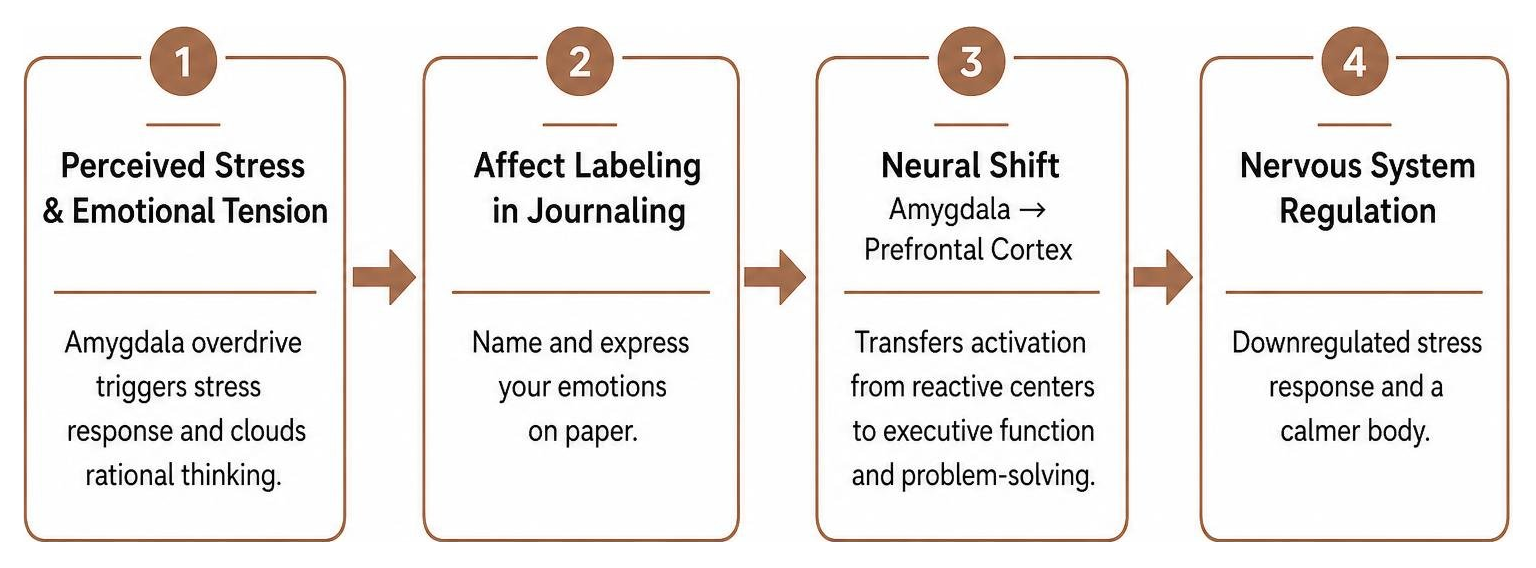
How a Daily Self Care Journal Transforms Emotional Regulation
When we experience overwhelm, our amygdala goes into overdrive. It sounds internal alarms, clouds our rational thinking, and floods our bodies with stress hormones.
The intentional act of labeling an emotion—often referred to in psychology as "affect labeling"—immediately downregulates amygdala reactivity. Naming our state ("I feel ungrounded," "I am exhausted from decision fatigue") transfers neural activation from the reactive emotional centers to the prefrontal cortex, which governs executive function and problem-solving.
Using an intuitive mood tracker app alongside short daily prompts allows us to spot the exact triggers behind our emotional shifts. Rather than feeling swept away by sudden frustration or low energy, we develop objective self-compassion. We can observe: "I am not broken; I am simply depleted after three back-to-back meetings without lunch."
Physical and Mental Health Synergies
Our minds and bodies exist in an ongoing conversation. Chronic psychological tension manifests somatically as poor sleep, shallow breathing, tense shoulders, and digestive upset.
Tracking physical cues alongside emotional states creates a complete wellness feedback loop. Recording daily markers like movement, nutrition, and rest through our daily health tracker guide reveals how tightly our physical care governs our mental bandwidth.
When we engage in a five-minute evening brain dump, we lower evening cortisol production, quiet racing thoughts, and prime the nervous system for restorative deep sleep.
Essential Elements to Include in Your Daily Routine
A successful self-care journaling practice does not require writing pages of prose. Instead, it thrives on structured, low-friction micro-check-ins that target specific dimensions of well-being.

Structuring Your Daily Self Care Journal for Maximum Impact
Dividing your journaling practice into two brief touchpoints bookends your day with intentionality:
Morning Alignment (2–3 Minutes):
- Intention: What energy do I want to bring into today?
- Gratitude: What is one small, ordinary thing I appreciate this morning?
- Support: What does my body or mind need to feel supported today?
Evening Decompression (2–3 Minutes):
- Release: What mental clutter or frustration am I choosing to let go of before sleep?
- Wins: What is one small moment of peace or accomplishment I experienced?
- Kindness: What is one kind thing I did for myself today?
To keep this structure effortless, you can use a flexible journal and notes feature that lets you record custom notes, log meals, and capture wellness thoughts without rigid constraints.
Core Prompt Categories for Mind, Body, and Soul
When staring at an open entry, guided categories remove decision fatigue. Here are actionable prompts to integrate into your daily check-in:
Mind (Cognitive Clarity & Boundaries):
- What is taking up the most mental space right now, and is it within my control?
- Where do I need to set a firmer boundary today to protect my peace?
- What limiting thought can I reframe into an encouraging truth?
Body (Somatic & Physical Restoration):
- How does my body feel right now from head to toe?
- Have I given myself adequate hydration, nourishment, and physical rest today?
- Where in my cycle or physical energy rhythm am I, and how can I honor that?
Soul (Gratitude & Connection):
- What brought a genuine smile or feeling of warmth to my chest today?
- How can I show myself unconditional compassion if things didn't go as planned?
- What words of reassurance do I need to hear right now?
How to Build and Maintain a Sustainable Journaling Habit
The biggest mistake people make when starting a self-care journal is setting unrealistic expectations. Promising to write three full pages every morning often leads to burnout and guilt within two weeks.
To make the habit stick, pair it with habit stacking and implementation intentions.
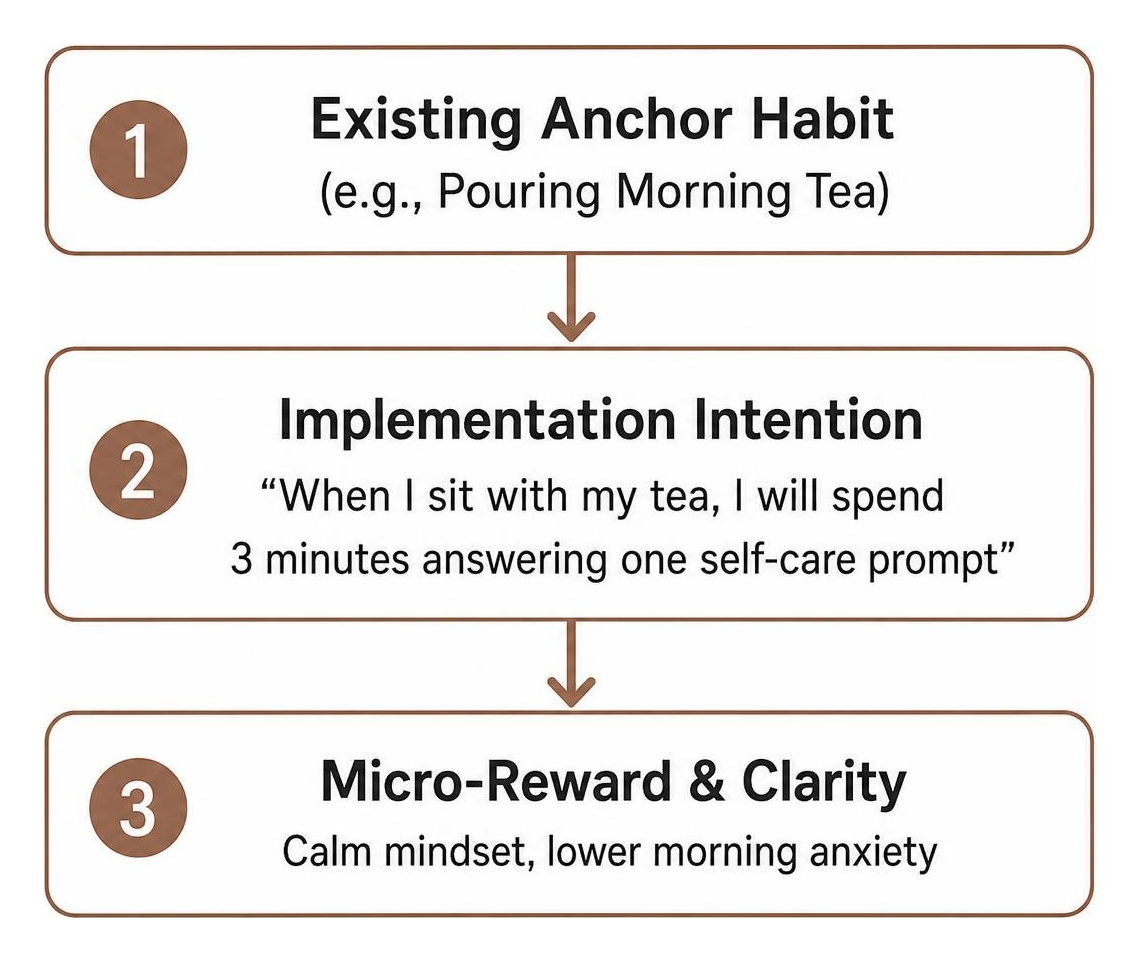
Behavioral psychologists Peter Gollwitzer and Paschal Sheeran demonstrated through a meta-analysis of 94 studies that utilizing implementation intentions—explicit "if-then" plans—dramatically increases habit adherence.
Instead of deciding vaguely to "journal more," anchor your practice: "When I sit down with my morning coffee, I will open my journal and answer two prompts."
Monitoring these daily repetitions using a daily weekly monthly habit tracker app provides visual momentum without adding mental overhead.
Overcoming Blank Page Anxiety and Perfectionism
Blank pages can feel intimidating. When we feel pressured to write profound prose, cognitive friction spikes, causing us to avoid the journal entirely.
- Embrace Skip-Friendly Formats: Missing a day is not a failure. Choose formats and apps that do not penalize you with empty dated pages or broken streaks.
- Set a Low-Lift Benchmark: Commit to writing just three bullet points. If you feel like writing more, wonderful. If not, three bullets fulfill your daily self-care check-in.
- Forget Grammar and Polishing: This writing is not a performance. It is a private emotional release.
Privacy in Digital Wellness Journaling
When capturing deeply personal thoughts—such as relationship boundaries, mental health struggles, and vulnerability—privacy is paramount. Storing raw reflections on public clouds or ad-supported platforms can create subconscious self-censorship.
| Feature / Consideration | Typical Cloud-Based Apps | Privacy-First Local Logging (Nama) |
|---|---|---|
| Account Requirement | Mandatory email/social sign-in | No account or sign-up needed |
| Data Storage | Remote corporate servers | 100% on-device local storage |
| Offline Accessibility | Often limited without active Wi-Fi | Fully functional offline anywhere |
| Monetization Model | Targeted ads / data monetization | Private, ad-free health journal |
| Data Ownership | Controlled by platform terms | Full text and photo export anytime |
Choosing an ad-free health journal ensures your reflections remain strictly your own, allowing for total honesty and genuine emotional healing.
Frequently Asked Questions About Daily Self-Care Journaling
How much time should I spend journaling each day?
You only need 3 to 5 minutes per day for self-care journaling to be effective. Consistency matters far more than duration. A focused 3-minute morning intention and 2-minute evening reflection provide substantial neurological and emotional benefits without draining your daily schedule.
What is the difference between a self-care journal and a regular diary?
A traditional diary logs events chronologically ("Today I went to the store, then met Sarah for lunch"). A self-care journal focuses intentionally on internal well-being, emotional regulation, physical health habits, and self-compassion. It acts as an active wellness tool rather than a passive history of your day.
Can a self-care journal help manage anxiety and burnout?
Yes. Clinical studies verify that expressive writing and mood logging reduce cortisol levels and calm amygdala reactivity. Journaling provides a safe space to offload mental loops, identify environmental triggers, and practice cognitive reframing, making it an effective first-line defense against burnout.
Cultivating a Mindful Practice for Long-Term Mental Clarity
Building a sustainable relationship with yourself starts with small, honest, daily check-ins. When we give ourselves permission to step away from distractions and listen to our bodies and minds, we build lasting emotional resilience.
Whether you are logging physical recovery, celebrating tiny daily victories, or offloading racing thoughts before bed, having an intuitive, completely private space makes all the difference.
Take the next step in your personal wellness journey and explore private wellness journaling features designed to keep your personal growth secure, offline, and entirely in your hands.