Free Exercise Log Sheets Printable to Keep Your Workouts on Target
The Best Exercise Log Sheets Printable Formats for Every Fitness Goal
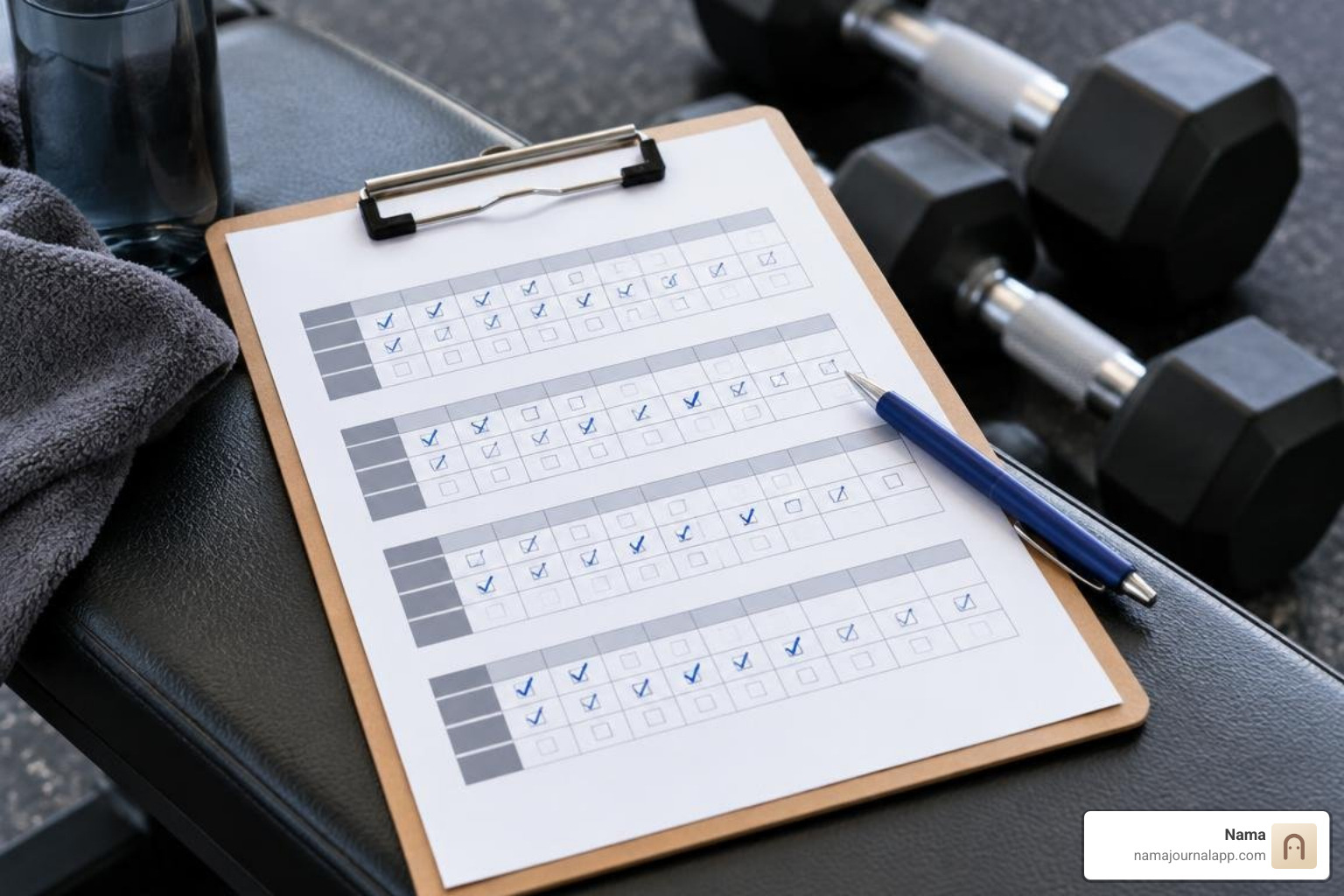
Finding the right template comes down to how your training week is organized. A single layout rarely fits every routine, which is why matching your template to your specific workout structure produces the best results.
Daily and 3-Day Workout Sheets for Strength Training
If you follow a classic push-pull-legs routine, an upper-lower split, or a full-body routine three days per week, structured sheets let you organize complex resistance training without clutter. A dedicated strength sheet typically dedicates a single page to one or several sessions, prioritizing multi-joint compound lifts (such as squats, deadlifts, and bench presses) before single-joint isolation exercises.
Using a structured bodybuilding workout tracker layout allows you to record your target reps, actual reps completed, and working weight for every set. This level of granularity is necessary for progressive overload—the practice of gradually increasing the stress placed upon the musculoskeletal system. You can also download a Printable Exercise Log (3 Days) to establish a clear, multi-day lifting framework that keeps each movement orderly.
Weekly Fitness and Habit Tracking Templates
For general fitness enthusiasts, athletes balancing cross-training, or anyone wanting a quick snapshot of their entire week on one page, weekly sheets offer a broad view. These templates feature seven daily rows alongside columns for activity type, total duration, subjective intensity, and notes.
Weekly formats are also ideal for habit stacking. You can record daily step goals, hydration levels, mobility sessions, or walks alongside your main training blocks. Applying practical weekly exercise log tips helps you spot lifestyle trends—like how a hectic workday impacts your evening gym performance. You can download a customizable Weekly Fitness Tracker | PrintablesWorld to easily keep all seven days visible on your desk or fridge.
Monthly Training Grid and Progress Planners
Monthly logs condense a 4-week block or a 12-week macrocycle onto a bird’s-eye grid. Rather than listing every single set, a monthly sheet typically features exercises along the rows and calendar dates across the columns. This format works well for linear strength programs (such as 5x5 routines), running schedules (like Couch to 5K), or simple consistency tracking.
A monthly view also highlights planned recovery. By writing "Rest" across non-training days or shading them with a specific color, you can ensure you are allowing adequate time for physical adaptation. To map out an entire phase of your programming, you can print a Free Monthly Workout Tracker — Printable Fitness Log PDF to view your consistency across all four weeks.
Essential Fields Every Printable Fitness Sheet Should Include
A poorly designed log sheet creates friction, while a well-structured one makes recording your sets intuitive. Whether you build your own template in a spreadsheet or print a ready-made PDF, incorporating the right fields is crucial. Using the core data columns found in a dedicated exercise log ensures you capture actionable metrics every time you train.
| Metric / Field | Strength Training Logs | Cardio & Endurance Logs | Lifestyle & Recovery Tracking |
|---|---|---|---|
| Primary Variable | Exercise Name & Muscle Group | Activity Type (Run, Row, Cycle) | Sleep Duration & Quality |
| Volume Metrics | Sets Completed & Reps per Set | Time / Duration Elapsed | Daily Water Intake (oz/liters) |
| Intensity / Load | Weight Used (lbs/kg) & % 1RM | Distance, Pace & Target Heart Rate | Rate of Perceived Exertion (RPE) |
| Density Metric | Rest Between Sets (Seconds) | Intervals / Split Times | Daily Steps or Active Minutes |
| Qualitative Data | Lifting Tempo & Form Notes | Terrain, Elevation & Weather | Energy Level, Soreness & Nutrition |
Designing Exercise Log Sheets Printable for Strength and Hypertrophy
Resistance training tracking requires precision. To ensure your template supports progressive overload, include dedicated fields for:
- Target vs. Actual Reps: Note your planned rep target alongside what you actually achieved (e.g., Target: 10, Actual: 8).
- Working Load: Record the exact weight lifted, including bar weight and fractional plates.
- Estimated One-Rep Max (1RM): Useful for calculating percentage-based training blocks. To estimate your 1RM, divide the weight you lifted by a factor based on the number of reps you completed: 1.0278 minus 0.0278 times the reps. For example, if you lifted 100 pounds for 5 reps, the factor is 1.0278 minus 0.139, or 0.8888, and your estimated 1RM is about 112.5 pounds.
- Lifting Tempo: Document concentric and eccentric timing (e.g., 2-0-2 for a two-second lowering, zero pause, and two-second lift) to standardize your mechanical tension.
- Rest Intervals: Track rest times between sets (e.g., 90s vs. 180s) to monitor training density.
Reviewing these variables against foundational exercise journal methods helps turn raw workout data into meaningful strength progression.
Tracking Cardio, Aerobic Intensity, and Recovery Metrics
For running, cycling, rowing, or functional conditioning, logging differs from weight training. You need to record aerobic output and internal cardiovascular strain:
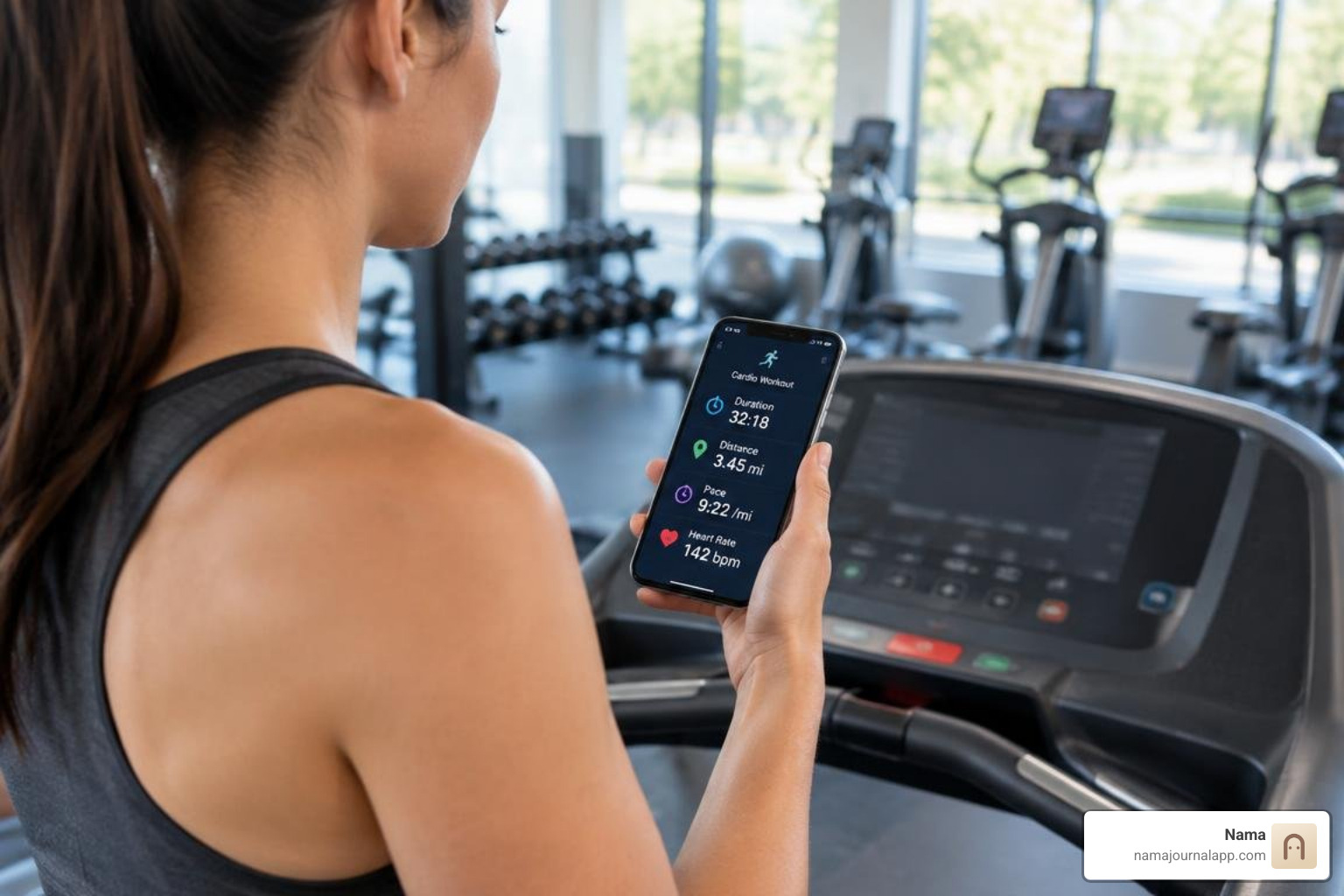
- Duration and Distance: The foundational volume metrics for aerobic conditioning.
- Subjective Intensity (RPE & Talk Test): Standardize your aerobic intensity using clear benchmarks:
- Light (RPE 1–3): You can sing a song or hold a continuous conversation.
- Moderate (RPE 4–6): You can talk in short sentences, but cannot sing.
- Vigorous (RPE 7–9): You are breathing hard and can only speak single words.
- Heart Rate Zones: Track average and peak beats per minute (BPM) to ensure you remain in your intended training zone.
- Energy Expenditure Realism: Avoid relying entirely on watch-estimated calorie burn. Consumer wearable estimates of energy expenditure are routinely off by 20% or more, especially for non-steady-state training. Focus instead on duration, distance, pace, and perceived exertion.
Paper vs. Digital Tracking: Why Analog Logging Still Works in 2026
Despite the abundance of fitness apps in 2026, paper tracking remains popular among dedicated lifters and everyday athletes.
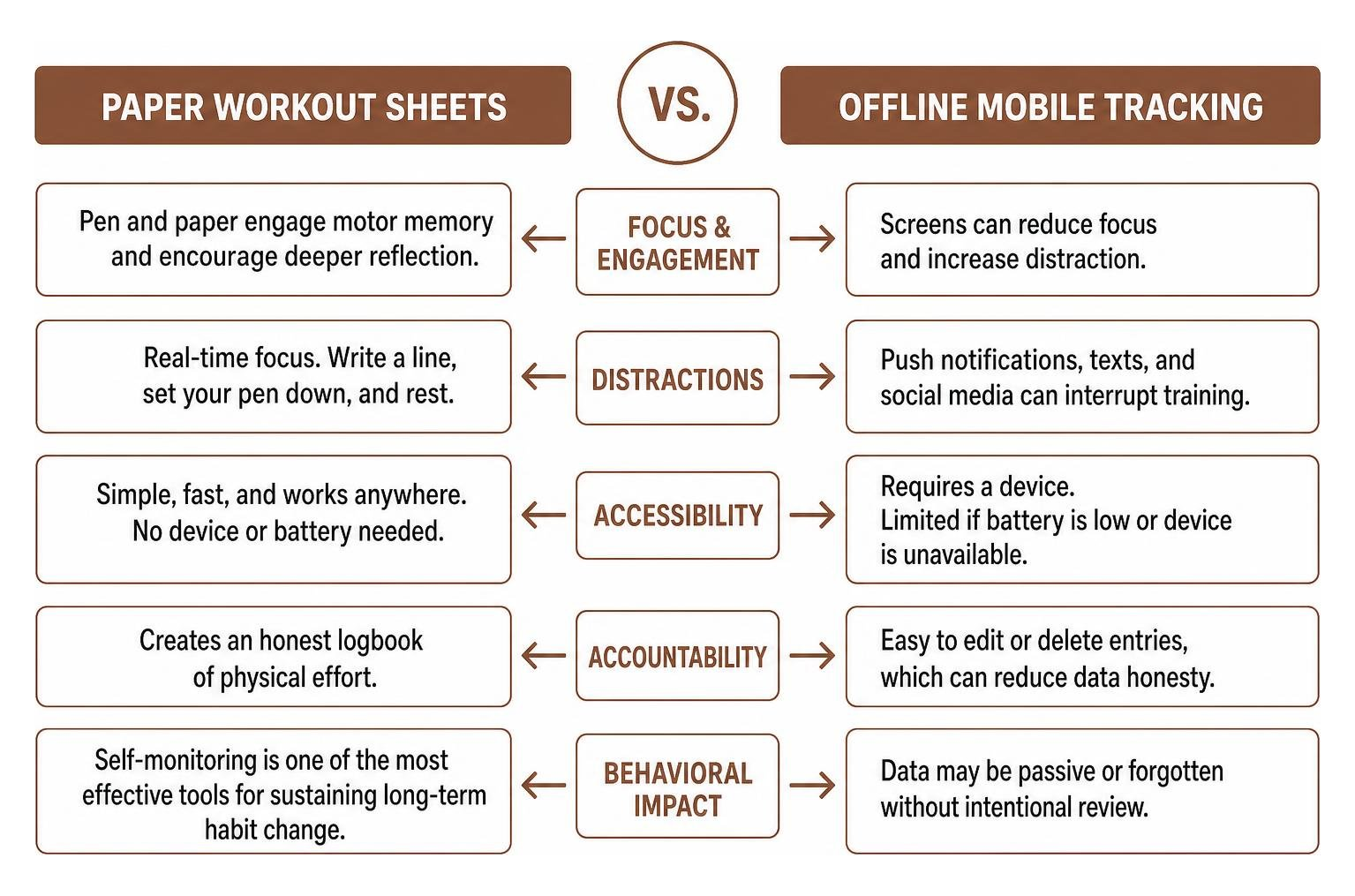
The Science of Pen and Paper Exercise Log Sheets Printable
The physical act of writing engages motor memory and encourages deeper cognitive reflection. In behavioral psychology, self-monitoring is recognized as one of the most effective tools for sustaining long-term habit change.
Writing down your lifts creates an honest logbook of physical effort. It provides real-time focus: you write a line, set your pen down, and rest before your next set—without the distraction of push notifications, texts, or social media feeds. This structured reflection fosters self-coaching and workout consistency, especially when you review past entries to identify what worked and what did not.
Comparing Physical Binders with Offline Digital Journals
While paper offers a tangible, screen-free experience, physical binders can become bulky, and taking paper into a busy gym risks spills and tears.
If you prefer digital logging without algorithmic feeds, social tracking, or cloud accounts, private mobile tracking offers a practical middle ground. Consulting our workout tracker app ultimate guide can help you decide whether a physical binder, a private on-device journal, or a hybrid setup best matches your training style.
Best Practices to Print, Organize, and Review Your Fitness Logs
A loose sheet of paper quickly ends up crumpled at the bottom of a gym bag. Setting up a durable physical system ensures your logs remain clean, organized, and easy to review.
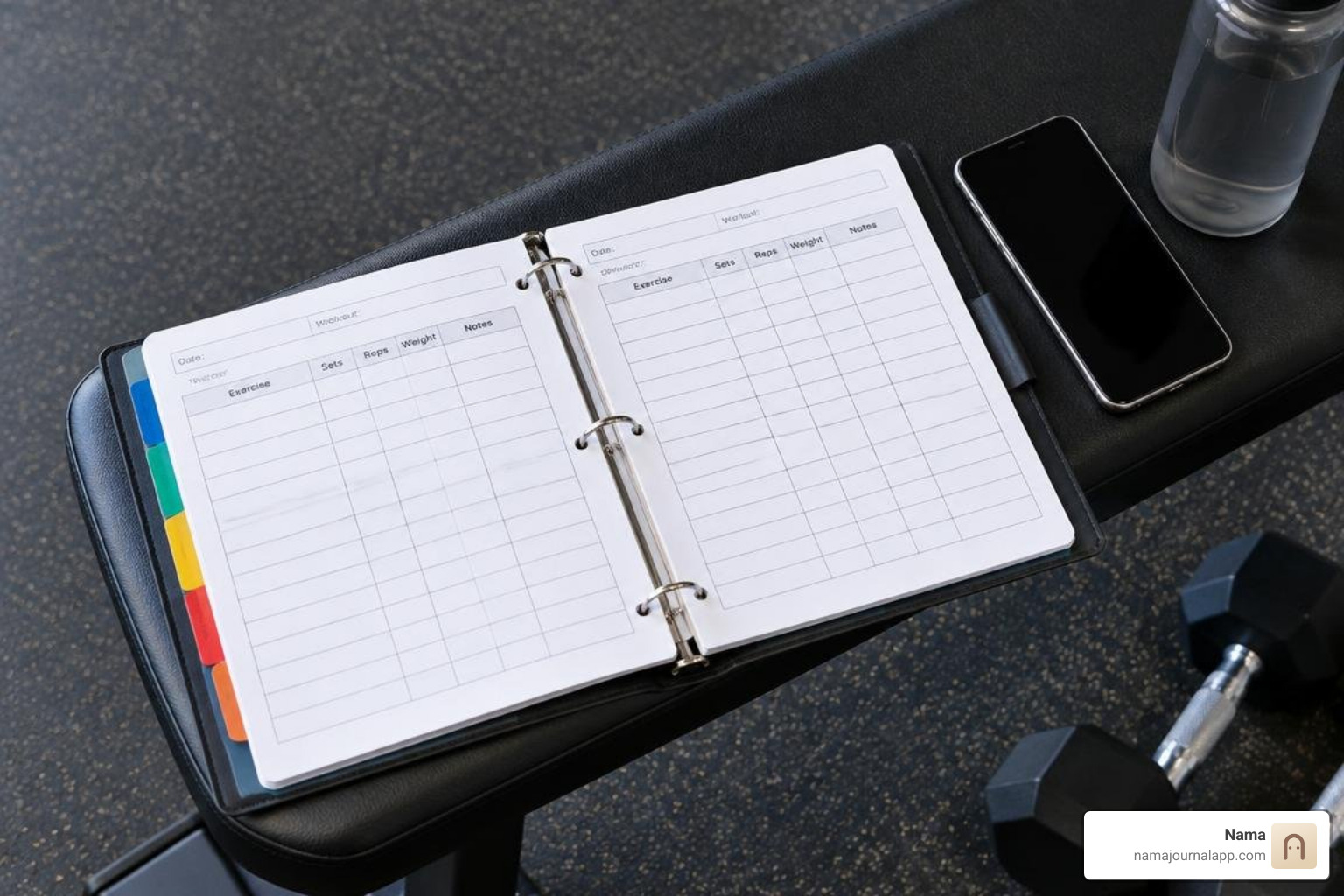
Optimal Printing Settings and Binder Setup
- Choose Durable Paper: Print your workout sheets on heavy 28lb or 32lb paper rather than standard 20lb printer paper. This prevents ink bleed-through when using gel pens or markers.
- Printer Configuration: In your print settings, select Landscape or Portrait depending on your layout, turn off "Shrink to Fit," set margins to "Fit Printable Area," and disable default browser headers and footers to maximize writing space.
- Double-Sided Printing: Print double-sided to cut page bulk in half and keep your binder compact.
- Use a Dedicated Binder: Store your sheets in a sturdy 1/2-inch or 1-inch, 3-ring binder. Add tabbed dividers labeled by mesocycle, training block, or focus area (e.g., Strength, Conditioning, Recovery).
- Opt for Undated Templates: Undated sheets let you print in bulk and start or pause your routine anytime without wasting pre-printed dates.
Conducting Weekly and Monthly Progress Reviews
Logging your workouts is only half the process; reviewing them is where you extract value. Applying consistent free exercise log tips ensures your logged data informs future programming adjustments:
- Audit Training Volume: Calculate total sets per muscle group each week. If progress stalls on your bench press or squat, check if your weekly working volume has dropped below effective thresholds.
- Correlate Lifestyle Variables: Review your notes column across several weeks. Persistent notes about sluggish workouts often point to external factors like poor sleep, work stress, or inadequate nutrition rather than a flawed training plan.
- Identify Plateaus: If your weight and rep numbers remain unchanged for three consecutive weeks, adjust your variables by altering your rep ranges, introducing a deload week, or swapping accessory exercises.
Frequently Asked Questions About Printable Workout Logs
How do I log strength exercises versus cardio sessions on one sheet?
To track both modalities on a single page, choose a split-page template with distinct sections for resistance work (sets, reps, weight) and aerobic training (duration, distance, pace, intensity). Alternatively, keep two separate sheets in your binder—one dedicated to your lifting program and another for endurance sessions.
How often should I update and review my printable exercise logs?
Record your sets, reps, and loads during your rest periods while the workout is underway. Add qualitative notes—such as joint comfort, perceived exertion, and energy levels—immediately after your final cool-down. Review your logs at the end of each week to assess consistency, and conduct a comprehensive progress audit at the end of every 4-week block.
Can I combine nutrition and habit tracking with my exercise log?
Yes. Many weekly layouts include dedicated columns for daily meals, water intake, sleep duration, and lifestyle habits alongside your exercise entries. Combining these metrics on a single sheet helps you spot patterns between your daily recovery habits and workout performance.
Keep Your Fitness Tracking Simple and Consistent
Printable exercise logs provide a clear, reliable, and distraction-free way to monitor your fitness progress. By removing digital noise, a physical sheet lets you focus entirely on your training, observe progressive overload, and hold yourself accountable session after session.
Whether you organize your training in a paper binder or use a private digital tool like Nama to log exercises locally on your iPhone without accounts or tracking, the core principle remains identical: measure your effort, review your progress regularly, and stay consistent. Explore our library of guides and choose a free online workout tracker system that fits your training routine today.